Skip to content
Emergency Services 24H

Emergency Plumbing → Burst Pipe

Pipe burst in house? Do these things right now

Four moves in the right order stop the damage. The third one is the step almost every guide leaves out, and it is the reason people think their shut-off valve has failed.

A pipe burst in house plumbing discharges continuously until the main valve is closed, and a single supply line can move hundreds of gallons in an hour. Repair runs $150 to $2,000 where the pipe is accessible, with a commonly reported average near $500.

A pipe burst in house pipework is stopped at one place only, the main valve. Everything below is ordered by what reduces the bill fastest, so act on the first section, then come back for the rest.

The first ten minutes

The four moves, in the order that matters

  1. 01

    Close the main valve

    Clockwise until it stops on a wheel handle, a quarter turn to crosswise on a lever. This is the only step that stops the supply.

  2. 02

    Open the lowest tap

    A basement faucet plus an outside spigot drains the water still standing above the break, which otherwise keeps feeding the leak.

Hand closing a lever-handle main water shut-off valve on a copper line
  1. 03

    Cut power if water is near it

    Only from a dry position. If you cannot reach the panel without standing in water, call the power company to cut supply at the meter.

  2. 04

    Photograph, then call

    Wide shots, then close shots, then the failed component kept aside. Call a licensed plumber with the water already off.

A pipe burst in house plumbing: why draining the system matters

Why open a tap after shutting off the water?

Because several gallons are still standing in the pipework above the break, and gravity keeps feeding them into your house after the valve is closed. Opening the lowest faucet and an outside spigot drains that column in under a minute.

This is the single most common reason a homeowner concludes the shut-off valve is broken. They close it, water keeps coming, and they panic. The valve is usually fine; the pipes above it simply have not emptied yet.

Open the lowest fixture you have, which in most homes is a basement laundry sink or a ground-floor bath. Add an outside hose bib if there is one. Leave them open until the flow stops entirely.

Do not attempt the repair itself

Licensed-plumber guidance published by Progressive is blunt on this point: do not try to repair a burst pipe yourself, because it usually leads to more damage. A clamp or self-fusing tape on a dry, depressurised pipe can buy a few hours. It is not a fix, and applying one to a live line under pressure can turn a joint repair into a section replacement.

When power comes before water

There is one situation where step three jumps to step one: water already in contact with outlets, appliances or the panel itself. Then electricity is the hazard and the water is the symptom.

Never cross standing water to reach a breaker panel. If you can get to it dry-shod and dry-handed, kill the affected circuit or the main. If you cannot, phone your power company and ask them to cut supply at the meter, which they do routinely and without charge in an emergency.

  • Any tingle from a metal fixture, tap or appliance means stop and call the power company immediately.
  • Appliances that have been rained on from above stay off until they have been checked, however dry they look.
  • A wet panel is never a DIY reset. Water tracks along busbars and stays there.
  • If anyone has had a shock, call 911 before you deal with the plumbing.

How to find a burst pipe inside a wall

A pipe burst in house walls is the expensive kind, because it runs unnoticed. Three checks locate most hidden breaks without opening anything.

  1. The meter test. Close every tap and appliance, then watch the water meter's low-flow indicator. Any movement means water is escaping somewhere on your side of the meter.
  2. Sound and touch. A hiss or a rushing sound behind drywall with all taps closed. Run a hand over walls and floors for an unexplained cold patch or a warm one over a hot line.
  3. Pressure pattern. Work through fixtures noting which have lost pressure. The break is usually upstream of the first weak one and downstream of the last strong one.

Stains, bubbling paint, a musty smell and an unexplained bill increase are the slower signals. Our page on the warning signs of a hidden burst goes through each one and what it rules in or out.

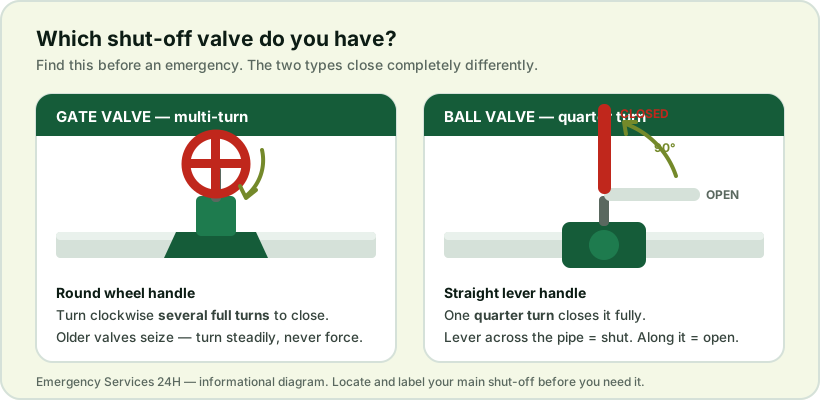
Diagram of gate, ball and stop-and-waste shut-off valve types with the closed position marked on each
Know which valve you have before you need it. A ball valve closes in a quarter turn; a gate valve can take several full turns and is the type most likely to seize. Source: Emergency Services 24H original diagram
Burst pipe: what to do in the first five minutes Stop. Call 911 first: Water running near outlets, a panel or a fuse box; A ceiling bulging heavily above a living space; Anyone receiving a shock touching taps or appliances; Scalding water flooding an occupied room. Contractor tonight: A supply line spraying and the main will not close; Water tracking into a second room or storey; A burst pipe in a wall cavity or under a slab; Any burst with no reachable isolation valve. Can wait for an appointment: A weeping joint you have already isolated; A burst outdoor hose bibb in mild weather; A pinhole caught early and clamped; Cosmetic staining once the water is off Burst pipe: what to do in the first five minutes Stop. Call 911 first Leave the building Water running near outlets, apanel or a fuse box A ceiling bulging heavily above aliving space Anyone receiving a shock touchingtaps or appliances Scalding water flooding anoccupied room Contractor tonight Damage is compounding A supply line spraying and themain will not close Water tracking into a second roomor storey A burst pipe in a wall cavity orunder a slab Any burst with no reachableisolation valve Can wait for an appointment Book in normal hours A weeping joint you have alreadyisolated A burst outdoor hose bibb in mildweather A pinhole caught early and clamped Cosmetic staining once the wateris off When in doubt, treat it as the more serious lane. A false alarm costs nothing.
Close the main first, then decide. Almost every burst drops a lane the moment the water stops moving.

What a burst pipe repair costs

Indicative US ranges. Always get a written quote.

Job Typical range
Burst pipe, accessible run $150–$2,000
Burst pipe under slab or concrete $500–$4,000+
Main water line repair from ~$225
Overall reported range $200–$3,000
Emergency call-out on top $75–$500 + $100–$350 / hr
Resulting water damage, severe cases $5,000–$70,000

Source: Angi burst-pipe repair cost data; Today's Homeowner emergency plumbing cost report; homeowner-reported figures from public forum threads, marked as reported (retrieved August 2026). Figures vary by region, severity and after-hours timing.

Figures last checked

Access, not the fitting, sets the price. The same copper joint failure is an hour of work in an open basement and a day of work under a slab, where the plumber has to locate the leak, break concrete, repair, and then make good.

That is also why a quote can legitimately rise once a wall is open. Ask for a fixed price to expose and diagnose, then a quoted repair once the damage is visible. Our breakdown of what emergency plumbing repair costs covers trip fees, minimums and the after-hours multiplier.

If the main valve will not close

Old gate valves seize. Forcing one snaps the stem or shears the gate off inside the body, and a contained leak becomes an open main.

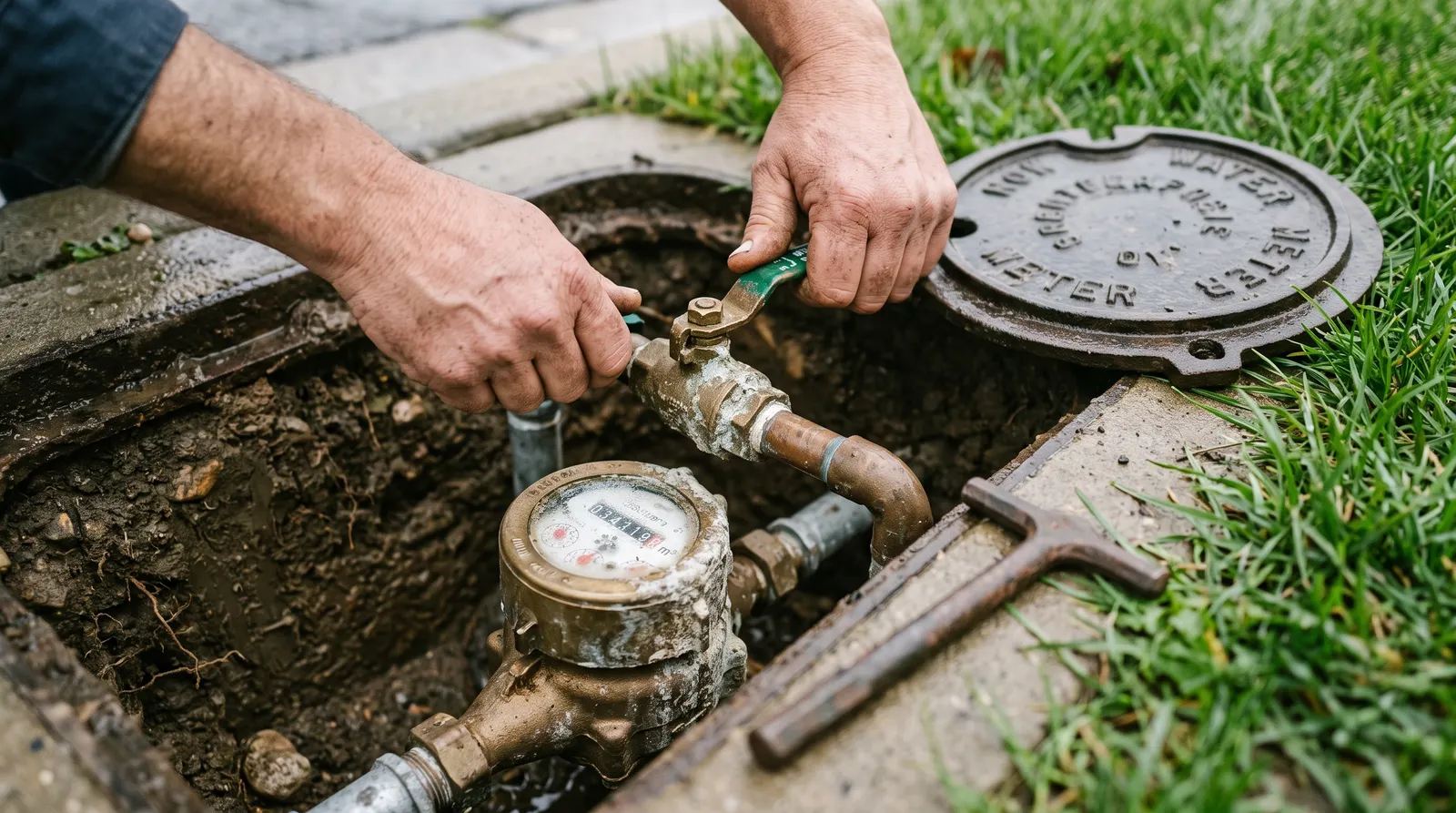
Try steady, even pressure and nothing more. If it will not move, go outside to the meter box near the kerb. That stop belongs to the water utility and is operated with a meter key, and your water company will close it for you if you call and say the interior valve has failed.

Will homeowners insurance pay for this?

Does homeowners insurance cover a burst pipe?

Usually the damage, not the pipe. Sudden and accidental discharge is generally what a policy responds to, which covers wet drywall, flooring and contents. The failed component and the plumbing labor to replace it are often excluded, and gradual seepage almost always is.

Keep the failed section. A split length of pipe is physical evidence that the failure was sudden rather than a slow leak someone ignored, and that distinction is what the claim usually turns on.

Log the times too: when you found it, when you closed the valve, when the plumber arrived. Policies generally require prompt mitigation, so a clear timeline supports the claim rather than undermining it.

What happens after the plumber leaves

The repair and the drying are two different trades, and people are regularly surprised by the second bill. A plumber fixes the pipe. Wet insulation, drywall and subfloor are a restoration job.

Wet fibreglass insulation inside a wall cavity rarely dries in place, and closed cavities are where mold problems start. If the water reached materials rather than tile, expect a drying contractor with air movers for two to four days.

When the plumber re-pressurises, ask to be there. Bring the system back slowly and walk every joint on that run, because a pressure spike sometimes finds the next weak point immediately.

24/7 dispatch network

Get a licensed plumber moving on this

Tell us what failed and your ZIP code. Licensed, insured plumbers covering your area will contact you directly. Submitting costs nothing and there is no obligation to hire.

Fire, a gas smell, or an injury? Leave the building and call 911 first, then your gas utility or power company. Use this form once you are safe.

By submitting this request you agree that Emergency Services 24H and the licensed contractors in its network may contact you at the phone number and email you provided, including by automated dialing system, prerecorded message, or text. Consent is not a condition of purchase. Message and data rates may apply. You can opt out at any time. See our privacy policy and terms.

Free to submit. No obligation to hire.

Know the line

Safe to check yourself, or call a pro now?

Safe to check yourself

  • Closing the main valve and draining the system from a low tap
  • Cutting power to a wet area from a dry position at the panel
  • Running the water-meter test to confirm water is still escaping
  • Photographing the failure and keeping the failed component
  • Extracting standing water and getting airflow across wet materials

Call a pro now

  • The pipe repair itself, on any line you cannot fully depressurise
  • Anything under a slab, inside a wall cavity, or below ground
  • A seized main valve: call the water company rather than force it
  • Water at or above the electrical panel, or a soaked appliance
  • Drying out closed wall cavities and wet insulation

How the matching works, and what we do not do

Emergency Services 24H is a referral service. We do not employ plumbers and we do not carry out the repair.

Your request routes by ZIP code to licensed, insured contractors covering your area, and they contact you directly to quote and schedule. Price is settled between you and them, which is why the cost table above is published rather than hidden.

Straight answers

Frequently asked questions

The questions homeowners actually search for on this problem, answered in plain language.

Browse all guides
What to do if a pipe bursts in your house?

Close the main water shut-off valve, then open the lowest faucet in the house to drain the pressure still sitting above the break. If water is anywhere near outlets, appliances or the panel, cut that power from a dry position first. Photograph everything before you mop, then call a licensed plumber.

Why would a pipe burst in a house?

Freezing is the usual cause: water expands as it turns to ice, pressure builds between the ice plug and a closed tap, and the pipe splits at its weakest point. High static water pressure, corroded old pipe, and physical damage from a nail or a fixing account for most of the rest.

Does homeowners insurance cover if a pipe bursts?

Policies generally respond to sudden and accidental discharge, so damaged drywall, flooring and contents are usually the covered part while the failed pipe and the repair labor often are not. Gradual seepage is normally excluded. Keep the failed section of pipe as evidence of a sudden failure.

How bad is a burst pipe in a house?

It depends almost entirely on how long it ran. A supply line can move hundreds of gallons in an hour, and the EPA puts the window before mold can establish in wet materials at 24 to 48 hours. Reported repair costs run from $150 on an accessible run to $4,000 or more under a slab.

When should I worry about pipes bursting?

Sustained sub-freezing temperatures, an unheated crawlspace or garage run, and any pipe on an exterior wall are the classic setup. The warning sign is a tap that slows to a trickle in cold weather, because that usually means an ice plug has already formed somewhere upstream.

Can I keep using water in the rest of the house?

Not once the main is closed, and that is the point. If you managed to isolate the break at a branch valve instead, the rest of the house can stay live, but check every joint downstream first. Running the system with a split open simply moves more water into the structure.

Homeowner turning a quarter-turn ball valve on a residential water meter in a curbside pit
Shutting the water off at the meter
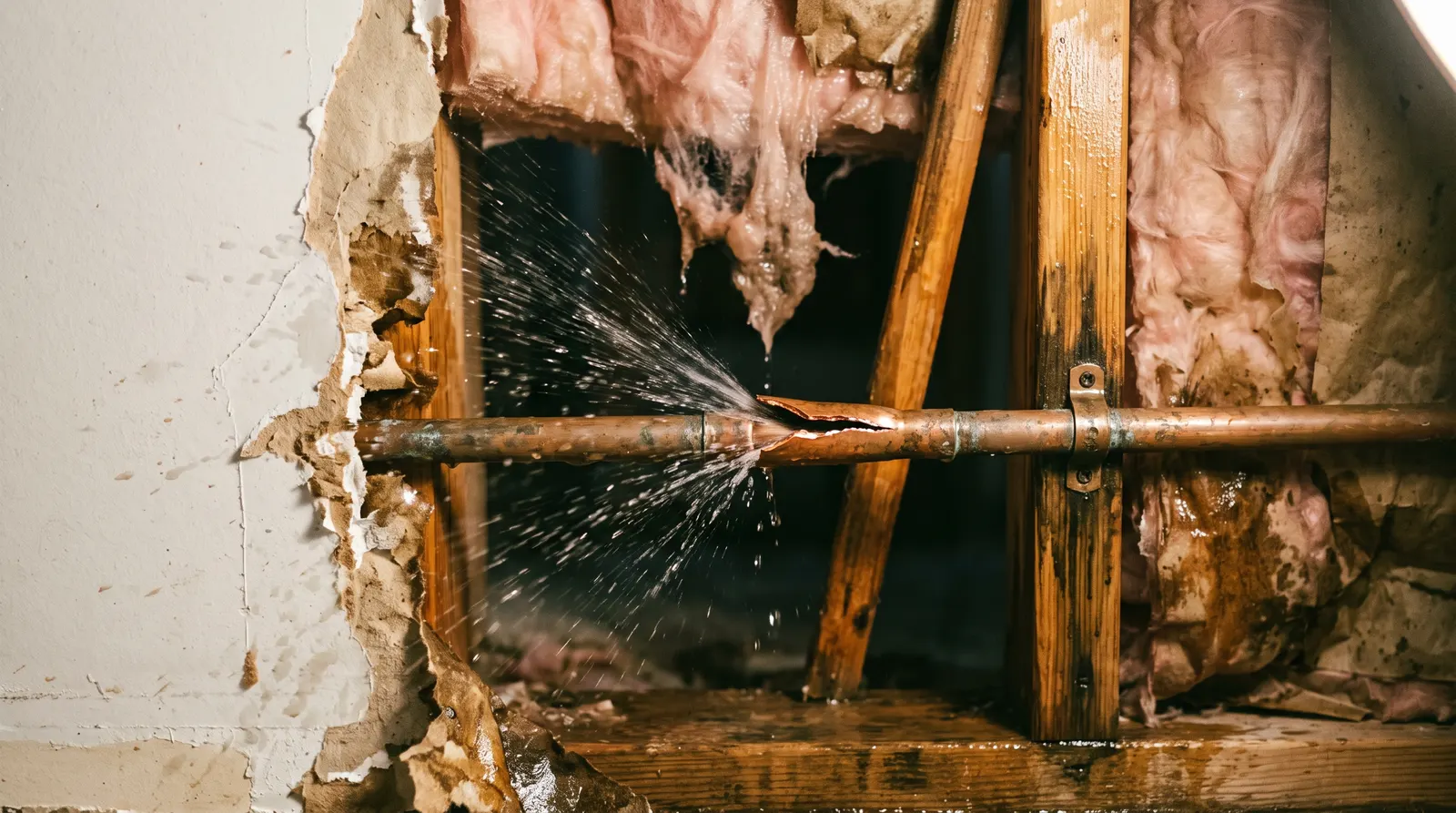
Split half-inch copper supply line spraying a fine fan of water inside a stud wall cavity
What a burst supply line actually looks like
Burst pipe repair: what the bill is made of After-hours call-out: $150 to $650, most often around $350. Accessible pipe repair: $200 to $600, most often around $350. In-wall or ceiling repair: $400 to $1,500, most often around $800. Under-slab repair: $1,500 to $4,500, most often around $2,600. Drywall and paint make-good: $300 to $1,200, most often around $600. Source: Aggregated 2026 US cost guides (HomeGuide, Angi, This Old House), cross-checked against UGC-reported prices. Burst pipe repair: what the bill is made of $0 $1k $2k $3k $4k $5k After-hours call-out $150–$650 Accessible pipe repair $200–$600 In-wall or ceiling repair $400–$1,500 Under-slab repair $1,500–$4,500 Drywall and paint make-good $300–$1,200 Most commonly reported figure Source: Aggregated 2026 US cost guides (HomeGuide, Angi, This Old House), cross-checked against UGC-reported prices
Access drives this bill far more than the pipe does. The same fitting costs four times as much under a slab as it does under a sink.

Sources for this page

Checked . If a figure here no longer matches its source, that is a bug, so tell us and we will correct it.

24/7 dispatch network

Get help from a licensed local contractor

Tell us what has failed and where you are. We route your request to licensed, insured contractors covering your ZIP code, and they contact you directly.

Fire, a gas smell, or an injury? Leave the building and call 911 first, then your gas utility or power company. Use this form once you are safe.

By submitting this request you agree that Emergency Services 24H and the licensed contractors in its network may contact you at the phone number and email you provided, including by automated dialing system, prerecorded message, or text. Consent is not a condition of purchase. Message and data rates may apply. You can opt out at any time. See our privacy policy and terms.

Free to submit. No obligation to hire.