Water heater leaking? Find the source before you call anyone
A water heater leaking has four leak points and four answers, three of them repairs measured in parts and an hour of labor. One means the tank is finished. Stored water sits at 120F while you work out which.
A leak at a top connection or the drain valve is usually a small parts repair inside one labor hour. A water heater leaking from the bottom of the tank body is corroded through and can only be replaced.
With a water heater leaking, the stored water sits at 120F or hotter, and on a gas unit a failing heater can vent badly at the same time. Make it safe before you diagnose it.
Before you diagnose
Make it safe: water, then power or gas
01
Close the cold inlet
The valve on the cold pipe entering the top of the tank. That stops the tank refilling as it empties through the leak.
02
Kill the energy source
Electric: switch off the dedicated breaker. Gas: turn the control knob to off. Do not touch the gas supply valve unless you smell gas and are leaving.
03
Keep clear of the discharge
Stored water sits at 120F or hotter. Relief-valve discharge and drain-valve water can scald, so do not put a hand in the flow to find the source.
04
Photograph, then call
Shoot the wet area, the tank label with its age, and the leak point. Those three photographs answer half of what a plumber will ask on the phone.
Cited source10:56
“Some people even go as far as replacing the water heater only to find out that the leak is still there.”
WO
Word of Advice TV
Working service technician
Word of Advice TV, 2025
An independent source we cite. Not affiliated with Emergency Services 24H, and not a network contractor.
Top connections mean a loose fitting; a dripping relief valve means excess pressure; water from the tank body means replacement.
Top connections. The hot and cold pipes entering the tank. Corroded nipples and loose fittings are the usual cause, and both are normally repairable.
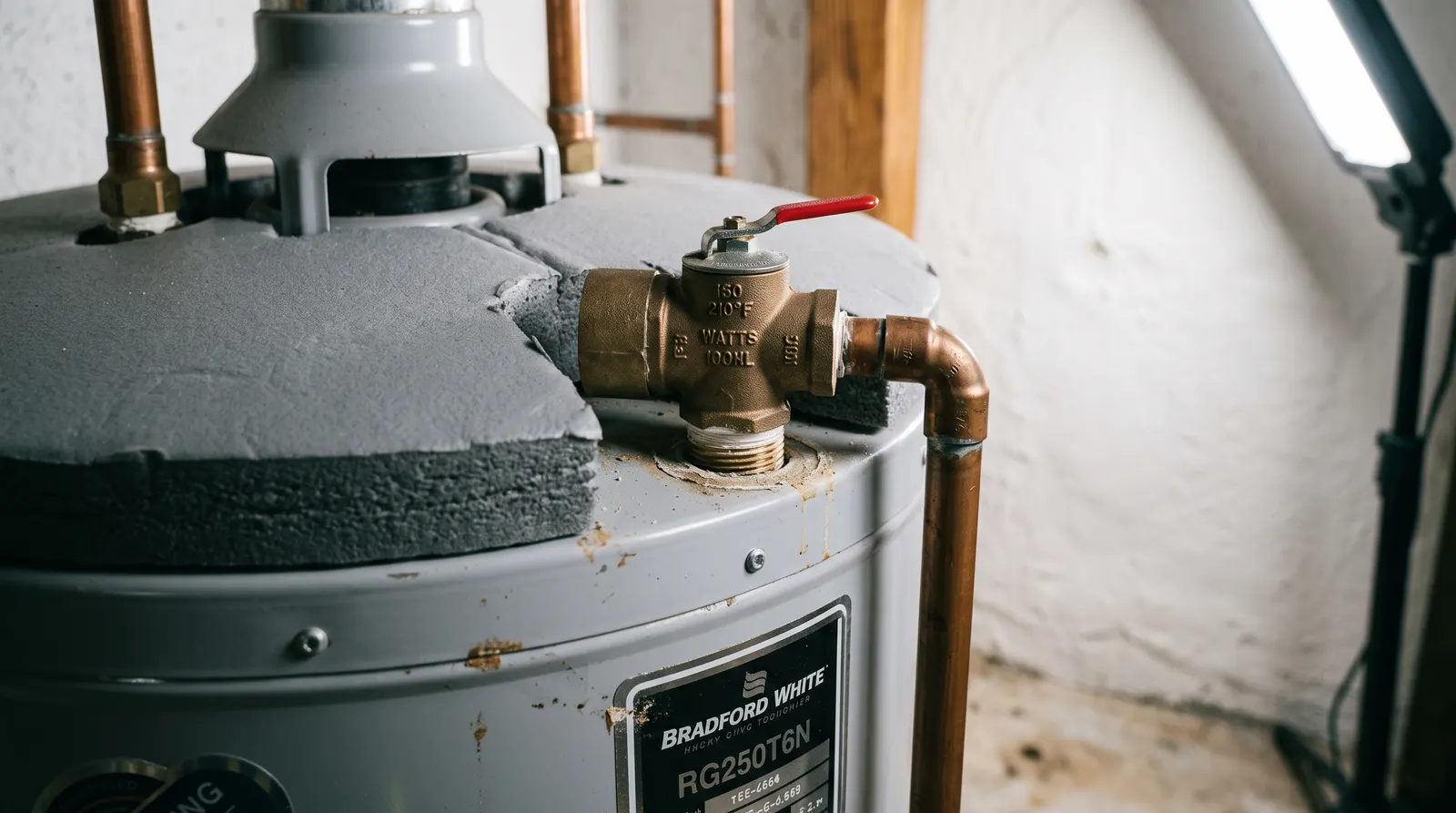
Temperature and pressure relief valve. The valve with a discharge pipe running down the side. Discharge is a safety function, not automatically a fault.
Drain valve. The tap-like fitting near the floor. A worn washer or a valve that never reseated after a flush, and an inexpensive part.
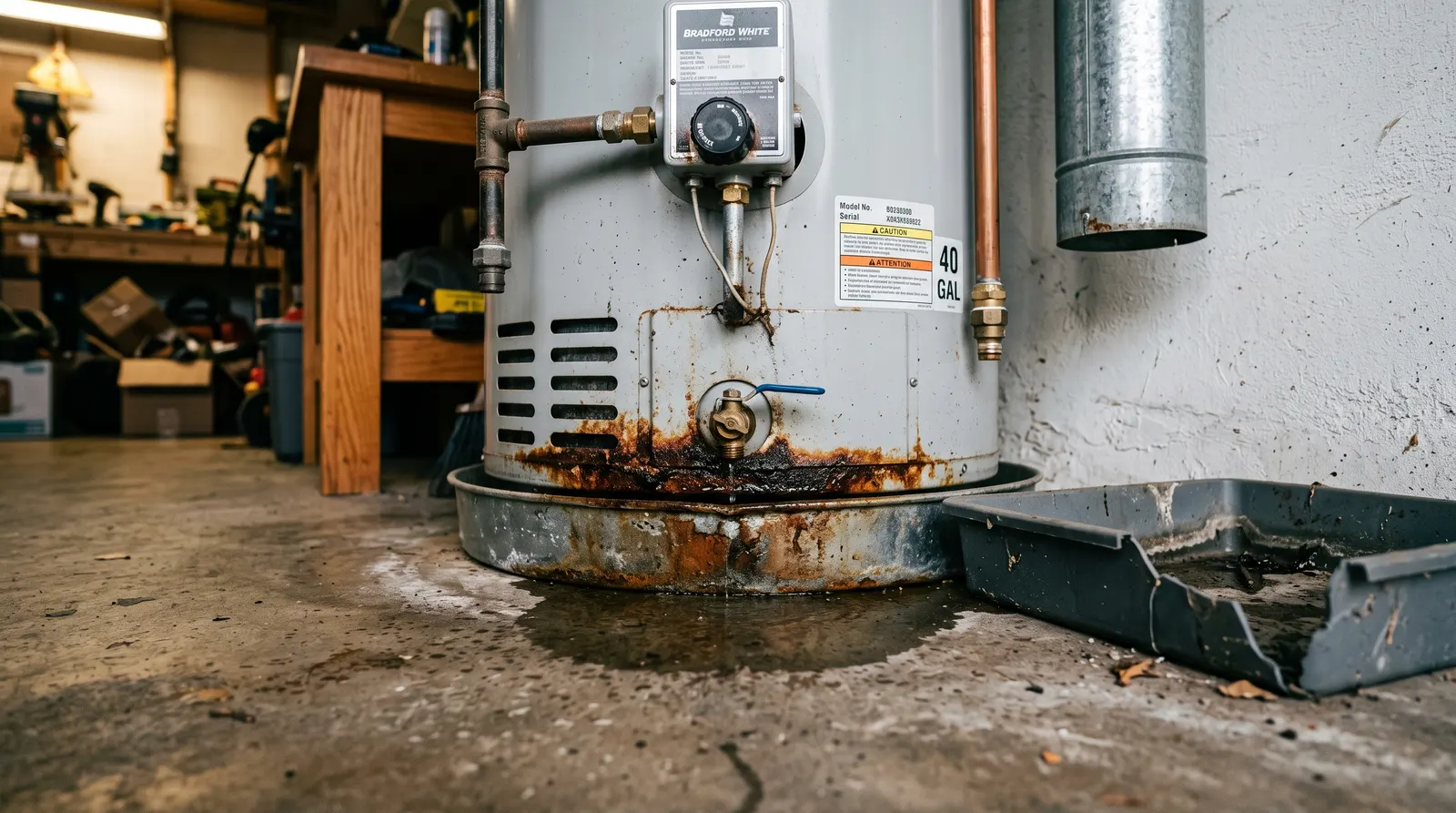
Tank body. Water emerging from beneath the jacket, or rust weeping at a seam. The glass liner has failed and the unit is finished.
How to find the real source in ten minutes
Water runs downhill and along surfaces, so where it pools tells you almost nothing about where it started. A puddle on the floor is equally consistent with all four sources.
A fifth possibility: the heater is not the leak. A service technician from Word of Advice TV reports calls where the source was a furnace beside it, and people replace the tank and find the leak still there.
His checklist is longer than four items: the relief valve body and outlet, the drain valve, the inlet and outlet fittings, the element gasket, the anode threads, and only then the tank.
There is a trap in the timing: metal expands with heat, so a crack widens while the unit runs. A leak that stops once the unit is off has cooled down, not healed.
Dry everything. The tank top, the fittings, the jacket and the floor. Completely dry.
Lay paper towel. Under the tank, around the base, and on top around the connections.
Wait thirty minutes. Do not use hot water during that window.
Read the towel. The first wet paper is directly under the source, because nothing has had time to travel.
Photograph the wet point and the rating plate showing the manufacture date. Age is half the repair-or-replace decision, and it is the first thing a plumber will ask.
What a dripping T&P valve is telling you
Every ranking page lists the relief valve as a leak source. None of them explains what a dripping one actually means, and the difference matters because it is the only leak on the tank that is a symptom rather than a fault.
A temperature and pressure relief valve opens when the water exceeds its rated temperature or pressure. If it drips persistently, the usual cause is house pressure that is too high or a thermostat set too hot, not a broken valve.
Replacing the valve without fixing the pressure gets you a new valve that drips. A plumber should check static pressure and, where it is high, look at a pressure-reducing valve or an expansion tank rather than just swapping the part.
Never cap, plug or reroute the discharge pipe upward
The discharge pipe exists so a tank cannot become a pressure vessel, and capping it removes the only protection the tank has. If it drips onto something you care about, have it re-routed to a drain.
The scald and gas hazards nobody mentions
Stored water is held at 120F or above, which is hot enough to scald in seconds. Do not put a hand into a discharge stream to trace a leak, and do not lean over a relief valve that is actively venting.
The gas risk sits alongside it and gets missed while attention is on the water. A gas water heater that is failing may also be back-drafting, which puts combustion products including carbon monoxide into the room rather than up the flue.
The CPSC treats a working carbon monoxide alarm as basic equipment wherever fuel-burning appliances are installed. If yours sounds, or if anyone in the house has an unexplained headache or nausea near the unit, leave the building and call 911 or your gas utility from outside.
Know the line
Safe to check yourself, or call a pro now?
Safe to check yourself
Closing the cold inlet valve at the top of the tank
Switching off the breaker, or turning a gas control knob to off
The dry-and-paper-towel test to locate the source
Photographing the leak point and the rating plate
Moving stored items clear and getting airflow over wet flooring
Call a pro now
Any repair on a gas water heater, which is separately regulated in most states
Replacing a temperature and pressure relief valve
Investigating high static pressure or fitting an expansion tank
Draining a tank you are not certain you can refill and restart
Any leak with a sulphur smell, which is a gas utility call first
Can I still shower with the water heater leaking?
Is it safe to shower while the water heater is leaking?
A short shower is usually fine if the leak is a fitting drip and the area around the tank is dry and being watched. Do not shower if water is pooling under the tank body, if the relief valve is discharging, or if there is any gas smell in the room.
The reason is mechanical rather than cautious. Drawing hot water pulls cold water into the tank, which raises internal pressure at exactly the moment the tank is least able to take it.
If the tank body is leaking, treat every draw of hot water as a small gamble. Corroded liners fail progressively and then suddenly.
Repair or replace, by source and by age
Manufacturers write most of the ranking content on this query, which makes their repair-or-replace advice difficult to weigh. The rule is simpler than their guides suggest.
Two findings end it: wet insulation around a gas unit’s burner chamber, or a visible crack in the tank threads. Either means the inner tank has gone.
A component leaking at the threads - relief valve, gas valve, element, anode - points at a loose fit or a failed gasket, and that is a repair while the threads are slightly damaged.
Top fittings or drain valve, any age: repair. Parts are inexpensive and the work is inside an hour.
Relief valve: replace the valve, then investigate why it opened. Skipping the second half means it will drip again.
Tank body, any age: replace the unit. There is no repair for a corroded glass liner and nobody sells one.
Any leak on a unit past ten to twelve years: price the repair against replacement before committing, because the next failure is usually not far behind.
A leak from the tank body itself is terminal. There is no repair for a perforated tank, only replacement.
What the call-out costs
Indicative US ranges. Always get a written quote.
Job
Typical range
Notes
Emergency trip fee
$75–$500
Charged to attend and diagnose
Labor, standard hours
$100–$200 / hr
Weekday business hours
Labor, after hours
up to $350 / hr
1.5×–2× the base rate
Fitting or drain-valve repair
small parts cost + labor
Usually inside one labor hour
Water damage cleanup, if it flooded
$1,000–$2,000+
Separate restoration trade
Source: HomeGuide 2026 emergency plumber cost guide; Angi 2026 emergency plumber cost data (retrieved August 2026). Figures vary by region and timing.
Figures last checked
Unit prices vary too widely by capacity and fuel for one honest figure, so what is published here is the labor side. The rest sits in our breakdown of the bill.
If water has spread across flooring, drying is a separate trade and bill. If the leak outruns the tank isolation, close the property main; our guide to the main shut-off valve covers where it is.
How much does replacing a leaking water heater cost?
Expect a materially larger bill than a repair: after-hours labor runs 1.5 to 2 times standard plus a trip fee. A fitting leak is parts and an hour, which is the difference worth establishing.
Can I keep using hot water while it leaks?
Only for a drip at a top fitting, watched. Water from the tank body is corrosion, and running the unit keeps it pressurised. Shut the cold inlet and the power.
Can I still use water if the water heater is leaking?
For a small drip at a top fitting, yes, briefly and watched. Water from the tank body is progressive corrosion, so every hour risks a full release.
Does a leaking water heater mean it needs to be replaced?
Only if the leak is from the tank itself. Inlet and outlet connections, the drain valve and the relief valve are normally repairable; water from beneath the tank body means the liner has corroded through.
Is it safe to leave a leaking water heater on?
Not overnight and not unattended. Shut the cold inlet, then the breaker or the gas control knob. Stored water sits at 120F or hotter, and a leaking gas unit may be venting badly.
How long will a water heater last once it starts leaking?
A tank-body leak is not something to plan around: some run for days, some open within hours. Past about ten years old, treat replacement as the only option.
Can I take a shower if my water heater is leaking?
A short one, if the leak is a fitting drip and the area is dry. Not if water is pooling, the relief valve is discharging, or there is a gas smell.
Why is the pressure relief valve dripping?
Because it is doing its job. A T&P valve opens when temperature or pressure exceeds its rating, so a persistent drip means house pressure is too high or the thermostat too hot.
Where a tank heater leaks from
The TPR valve and its discharge pipe
If the tank itself has failed and the unit is past about ten years, replacement is usually the cheaper decision even when a repair is technically possible.
Independent, publicly published sources, quoted with attribution and linked in full.
None is affiliated with Emergency Services 24H, reviewed this page, or works in the referral network.
Word of Advice TV: Working service technician - “Hot Water Tank is Leaking? Top 8 Easy Things to Check” (2025)
Tell us what has failed and how soon you need someone. We route your request to licensed, insured contractors covering your area, and they contact you directly.
Fire, a gas smell, or an injury? Leave the building and call 911 first, then your gas
utility or power company. Use this form once you are safe.