A dishwasher not draining leaves standing water in the sump, and the drain path has five points: filter, sump, pump, hose, disposal. Four of the five cost nothing and take under an hour to check. One of them is why a brand new machine has never drained at all.
A dishwasher not draining leaves standing water in the sump because the path from filter to pump to hose to disposal is blocked. Four of those five checks are free; only the pump costs money.
Working them in order is the difference between a five-minute fix and a service call.
First, get the water out
Every guide starts here and none of them explain how, which matters because the sump holds more water than it looks like it does.
Cut power at the breaker, lay towels down, and scoop out the draining water with a cup until towels or a wet vacuum finish it.
The drain path, in order
Four checks before you call anyone
01
Cut power, then bail
Switch the circuit off at the breaker, lay towels down, and scoop the standing water out with a cup before finishing with towels or a wet vacuum.
02
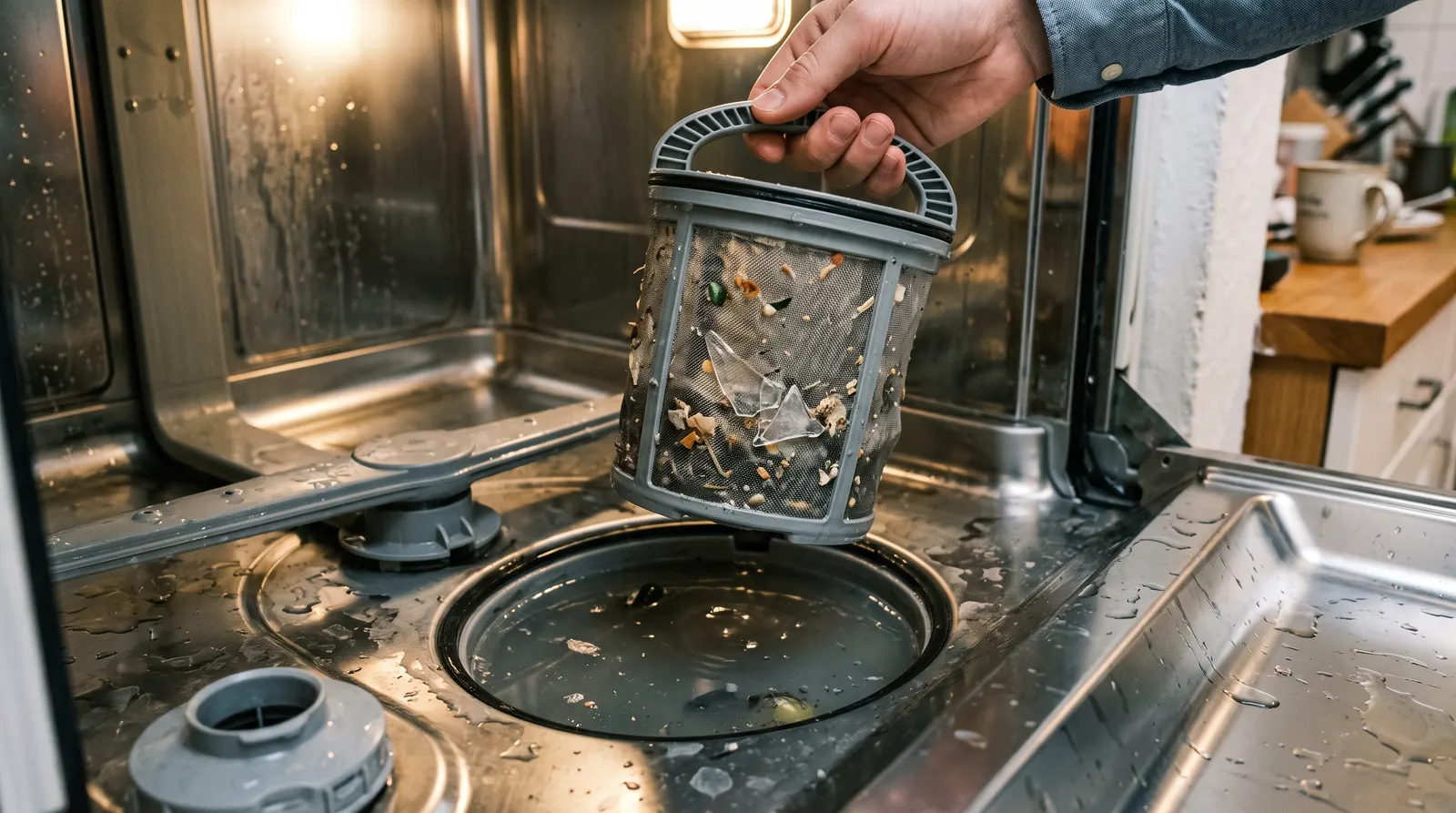
Pull the filter and look underneath
Twist and lift the cylinder filter, wash it in warm water with a soft brush, then check the opening beneath it for glass, seeds and label paper.
03
Follow the drain hose
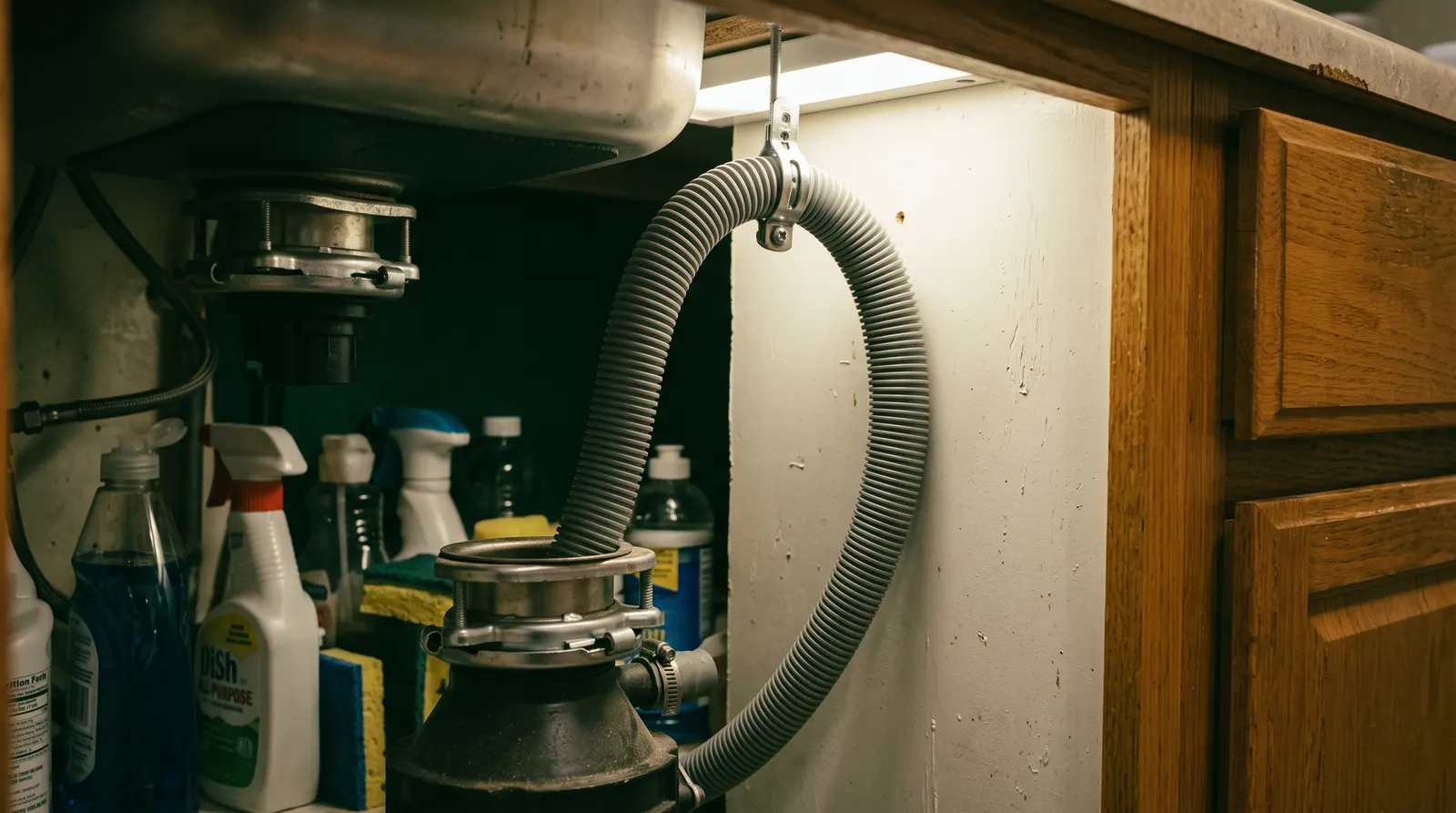
Look under the sink for kinks, and check the hose rises into a high loop before it drops. Without that loop, sink water siphons straight back into the machine.
04
Check the disposal connection
Run the disposal, then check the inlet nipple. On a new install, the knockout plug inside it is the single most common reason a dishwasher has never drained.
Dishwasher not draining? Start at the filter
Where does a dishwasher blockage usually sit?
In the filter assembly and the small opening beneath it. Standing water in dishwasher sumps almost always stops here.
To unclog a dishwasher, twist the cylinder filter counter-clockwise and lift it out. Clean the filter under warm running water with a soft brush until the mesh is genuinely clear, then remove standing water from the drain basket.
Then inspect the drain opening it came out of, where the hard fragments end up. Doing it monthly will help prevent clogs.
New dishwasher? It is the knockout plug
This one fact resolves more brand new installations than everything else on this page combined.
Garbage disposals ship with the dishwasher inlet sealed by a molded plug that the installer must knock out before connecting the hose. Miss it and the machine pumps against a solid wall, with dishwasher water going nowhere.
A machine that has never drained once
If the dishwasher has worked correctly before, the knockout plug is not your problem. If it has never completed a cycle since installation and it drains into a disposal, check the plug before anything else.
The drain hose and the high loop
The drain hose should rise to just under the countertop before dropping to the disposal or the standpipe.
That rise is the high loop, and it stops sink water siphoning back into the machine. Installers skip it in retrofits, so check for kinks while you are under there.
High loop: hose secured up under the counter before it drops.
Kinks: commonly right behind the machine where it was pushed back into place.
Air gap: the small chrome cylinder on the sink, where local code requires one.
Sink drain: if the sink is slow, the blockage is plumbing rather than appliance.
Disposal, air gap and the sink side
Half the time a dishwasher is blamed for a plumbing problem it shares an outlet with.
Run the disposal for thirty seconds, then the tap. A slow sink means the blockage is downstream of both appliances, and the air gap can clog and produce identical symptoms.
This is the last check rather than the first, because a blocked path makes a healthy pump sound exactly like a failing one.
Start a cycle and listen at the drain phase. A hum with no water movement suggests a jammed or failed pump, and total silence suggests the pump, its wiring or the control board. Clear the filter and hose before spending anything.
Where this page’s information comes from
Most pages here quote a named technician working through the fault. This one cannot, and that is worth stating.
The technicians whose material informs this section document refrigeration, dryers and gas ranges, not a draining dishwasher. The sequence above comes from manufacturer installation documentation, where the knockout plug, high loop and air gap cylinder are stated requirements.
The caveat is ordering, not accuracy: each cause is real and each check is safe, but we cannot say which a technician finds most often.
Can you force it to drain?
Is there a drain-only cycle?
On most machines yes. Holding the cancel button for a few seconds starts a cancel and drain routine that runs the pump and empties the tub.
Use it as a test too. A machine draining fully on a forced cycle and filling again on a normal one is telling you the pump works.
Clear the filter basket and check the disposal knockout plug before calling anyone. Between them they account for most drainage complaints.
What this repair costs
Indicative US ranges. Always get a written quote.
Job
Typical range
Notes
Filter and sump clearing
no part cost
The most common cause by a distance
Knocking out the disposal plug
no part cost
New install that has never drained
Re-routing or replacing the drain hose
low-cost part
Kinks, pinholes and a missing high loop
Air gap cleaning
no part cost
Where local code requires one
Drain pump replacement
mid-cost repair plus diagnostic fee
The 50 percent rule (per our repair-or-replace guide) applies on an older machine
Source: Fixr 2026 appliance repair cost data, with part-level costs stated qualitatively where no published figure exists (retrieved August 2026). Figures vary by region and timing.
Figures last checked
The top four rows cost nothing, which is unusual for an appliance fault and worth the twenty minutes before booking anyone.
Drawn from real public forum threads and reported prices, summarized and attributed as patterns.
These are not reviews of this site, and no names or ratings have been invented.
“What causes a dishwasher not to drain completely?”
SourceThread title from a community Q and A that ranks on this SERP. The recurring first answer is the filter and the sump, not the pump people fear.
“New dishwasher installed, will not drain, disposal is new too”
SourceA pattern repeated across appliance and plumbing forums. The consensus answer is the garbage disposal knockout plug, which ships sealed and has to be removed at install.
“Google AI Overview leads with removing standing water, cleaning the filter and checking the disposal inlet”
SourceThe live AI Overview for this query, citing Reddit, YouTube and manufacturer support. Useful confirmation that the free checks come first.
1 / 3
The knockout plug is the standout pattern in those discussions, because it is invisible from the machine and obvious once you know it exists.
How the matching works, and what we do not do
Emergency Services 24H is a referral service. We do not employ appliance technicians and we do not sell parts.
Your request routes to licensed, insured technicians covering your area. If the filter and hose fix it, you owe us nothing.
Cited source0:43
On the line between homeowner checks and work that means disconnecting a drain line or moving a machine with live wiring behind it.
“If you're not comfortable doing that, please call a technician.”
M
Matt
Technical trainer, OEM appliance parts retailer
AppliancePartsPros.com, 2023
Bias to weigh: Works for a parts retailer, so the recommended fix is usually a part.
An independent source we cite. Not affiliated with Emergency Services 24H, and not a network contractor.
How do I clear standing water in a dishwasher before I start?
Cut power at the breaker first, lay towels down, then scoop with a cup until you can finish with towels or a wet vacuum. Working in standing water with the circuit live is the one genuinely dangerous part of this job.
Can a blocked drain hose stop a dishwasher draining completely?
Yes, and it is the second most common cause after the dishwasher filter. Look for a kink behind the machine, and check the hose rises into a high loop before it drops to the disposal.
Why is there standing water at the bottom of my dishwasher?
Something on the drain path is blocked. In order of likelihood: the dishwasher filter and the opening beneath it, a kinked drain hose, a blocked disposal connection, a clogged air gap, then the pump.
How do I force my dishwasher to drain?
Most machines have a cancel and drain function, usually a long press on cancel. It will empty the dishwasher so you can work, but it does not fix the blockage.
My new dishwasher has never drained. Why?
Almost certainly the garbage disposal knockout plug, which the installer has to knock out before connecting the hose. If it was missed, the machine has nowhere to drain to.
How do I test a dishwasher drain pump?
Listen during the drain phase. A hum with no water movement suggests a jammed pump; silence suggests the pump, its wiring or the control board.
Is it the dishwasher or the sink?
Check the garbage disposal and run the sink first. A slow sink means plumbing, not appliance.
How much does it cost to fix a dishwasher that will not drain?
Nothing if it is the filter, the hose or the knockout plug, which covers most cases. A drain valve or pump replacement is mid-cost once labor and the diagnostic fee are in.
The sump and filter basket
The drain hose high loop
A newly installed disposal with the knockout plug still in place is a classic cause, and it costs nothing to fix.
Tell us what has failed and how soon you need someone. We route your request to licensed, insured contractors covering your area, and they contact you directly.
Fire, a gas smell, or an injury? Leave the building and call 911 first, then your gas
utility or power company. Use this form once you are safe.