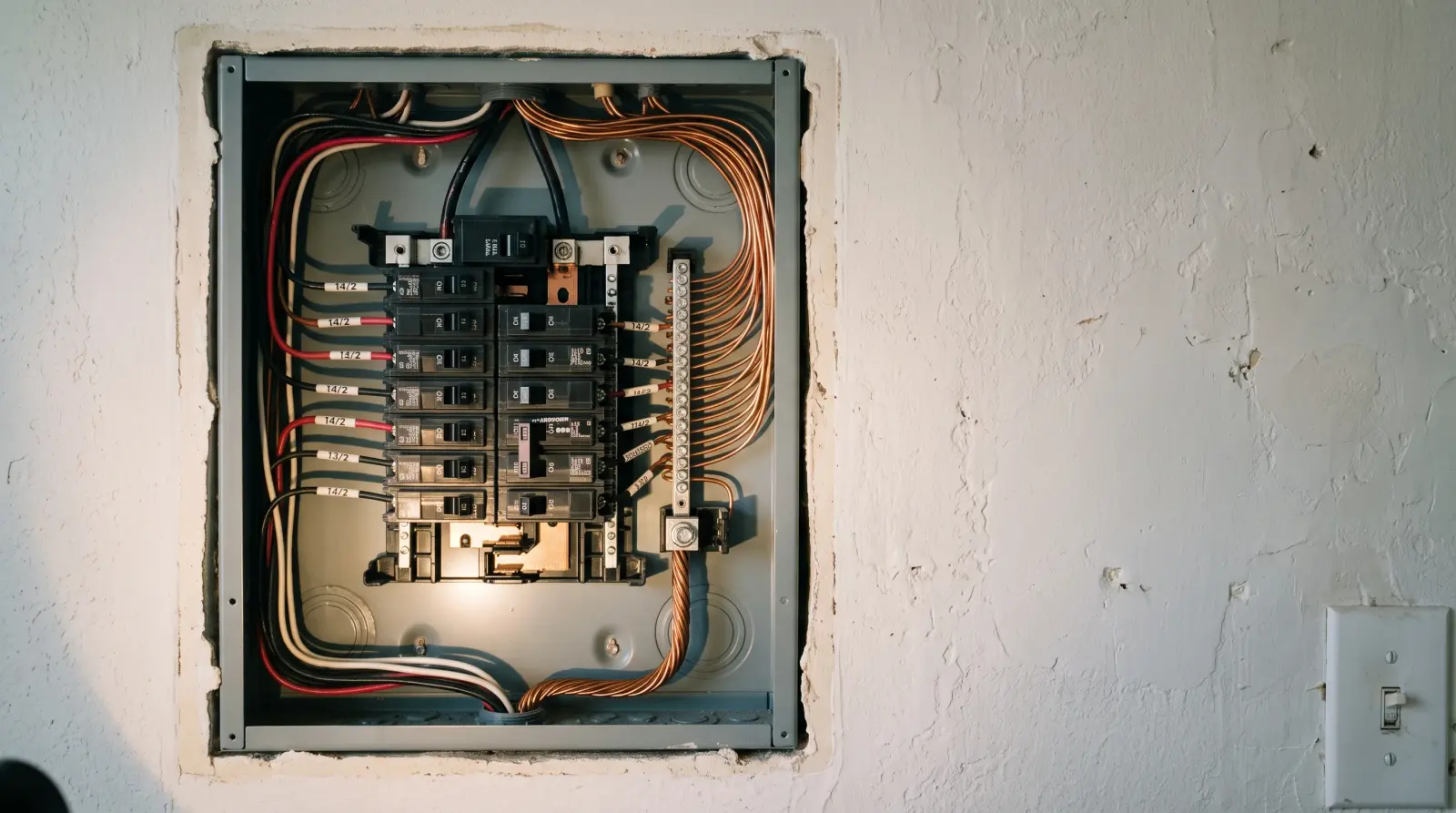
A breaker won’t reset for three reasons, and they are not equally serious. One is a ten-second technique problem; the other two are a live fault, which ESFI ties to more than 28,000 home fires a year (ESFI, read 2026-07-22).
A breaker won’t reset for one of three reasons: it was never pushed fully past the middle position to off, a short circuit or ground fault is still live on the circuit, or the breaker itself has failed.
Work them in that order and you will either restore power in ten seconds or learn something genuinely useful about the fault.
Why a breaker won’t reset: three causes
What does it mean when a breaker will not reset?
Ten-second fix first
The reset technique that actually works
01
Clear the circuit
Unplug every device on it, and switch off anything hardwired you can reach: lights, extractor fans, a garage door opener. The circuit must be genuinely empty.
02
Push fully to off
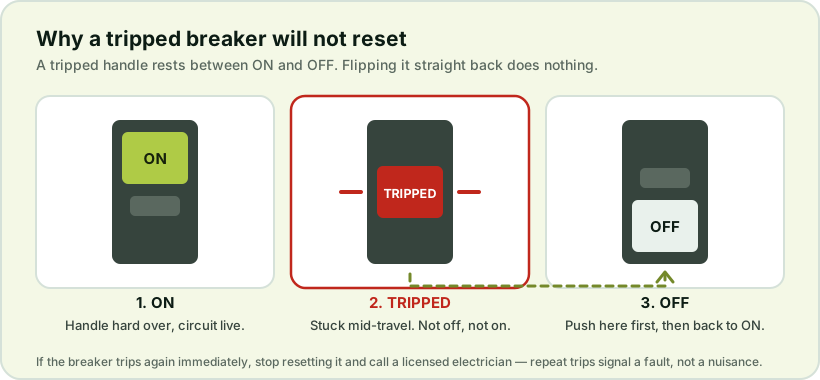
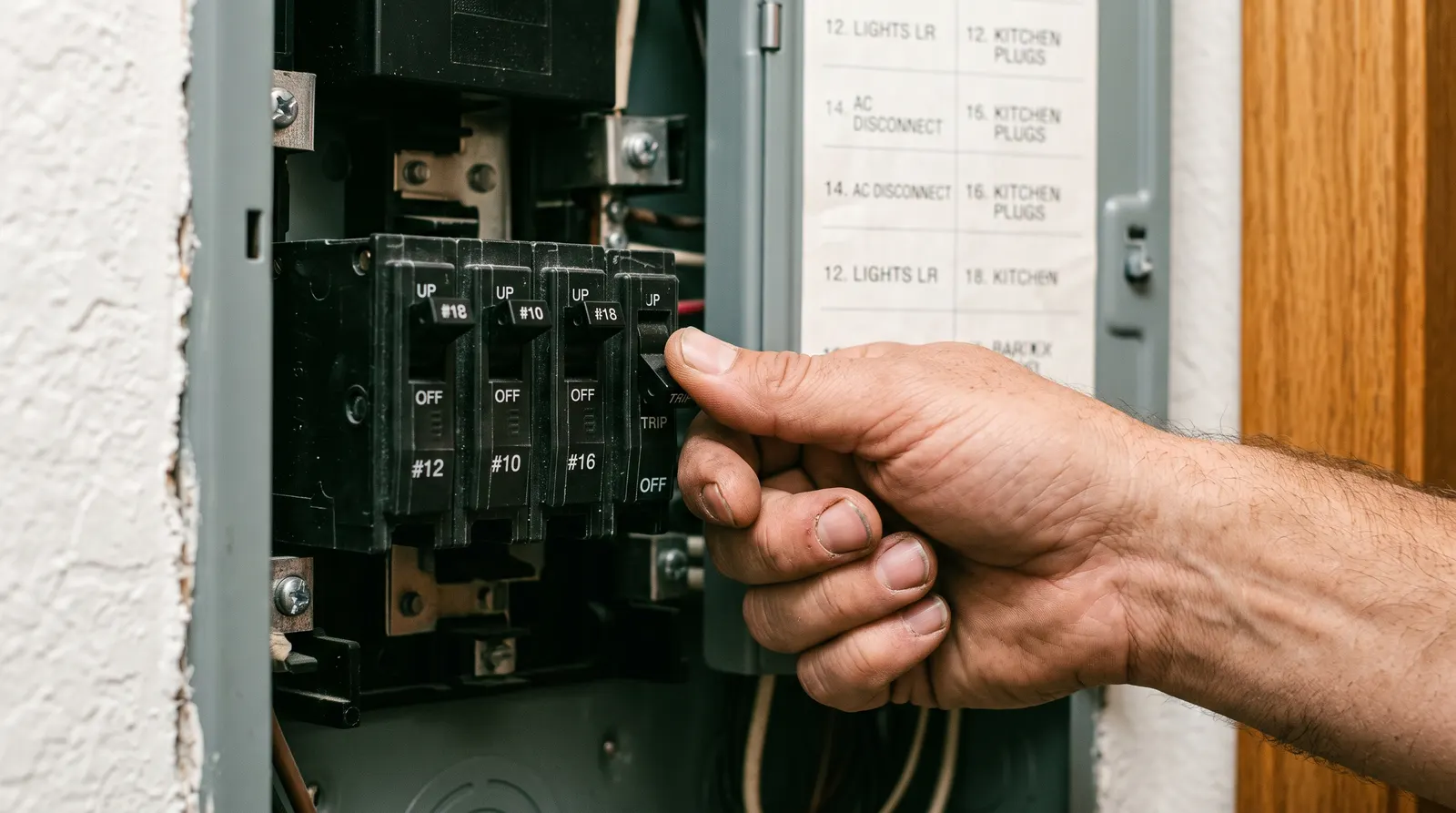
A tripped breaker rests in a middle position that looks close to on. Push the handle firmly past that center point until it seats in off.
03
Then back to on
One firm movement. You should feel and hear it seat.
04
Read the result
Holds, so reintroduce devices one at a time; trips instantly, so treat it as a live fault; will not move at all, which points to a mechanical or internal failure.
Cited source~6:39
“in order to reset a breaker, should you ever have to reset, this is the correct way, you have to turn it off and then all the way the other way to on.”
TA
Thomas Adams
Oregon master electrician and business owner
Classic Electric, 2026
An independent source we cite. Not affiliated with Emergency Services 24H, and not a network contractor.
Almost every "breaker won’t reset" call that turns out to be nothing is this. The handle has three positions and people only expect two.
A tripped breaker rests between on and off. Pushing toward on from the middle position does nothing, which is why it feels like the breaker has failed when it has not.Source: Emergency Services 24H original diagram
Will not move, or trips back instantly?
Will not move at all. The handle feels solid or spongy and does not seat.
Seats, then trips back instantly. The breaker is working perfectly.
Seats, then trips after a delay. That is an overload rather than a fault, and it is the least serious of the three.
Seats and holds, but no power. The breaker was not the problem.
The electrical emergency guide covers the circuits either side of this one, and Emergency Services 24H routes the call to licensed electricians nearby when a circuit breaker tripped and won’t reset.
What an immediate re-trip proves
A breaker switch won’t reset while the fault is live, which is a different symptom from a circuit breaker that keeps tripping minutes or hours later. Tripped and won’t reset means now; trips and won’t stay on later usually means load.
An instant re-trip on an empty circuit is one of the more definitive results in home electrics.
That matters because it takes the problem out of homeowner territory entirely.
It also raises the stakes on further resets. ESFI attributes more than 28,000 home fires a year and over $700 million in property damage to arcing faults (ESFI, read 2026-07-22), and every reset re-energises whatever is arcing.
Stop resetting entirely if any of these are present
A burning smell, a warm breaker, scorching around the terminals, or buzzing from inside the panel all mean the fault has already produced heat. Leave the breaker off, do not open the panel, and call a licensed electrician tonight.
When the main breaker will not reset
A main breaker protects the whole installation, so when it refuses to hold you have lost the entire house rather than one circuit.
Is it the breaker or the circuit?
How do I know if the breaker itself is faulty?
A breaker that trips below its rated load, feels warm, has a loose or spongy handle, or shows discolouration at its terminals is suspect.
An electrician confirms the circuit is healthy, usually by disconnecting it at the panel and metering for continuity between conductors, before they conclude the device has failed.
Dustin Stelzer of Electrician U gives the physical tells of a breaker that has genuinely failed. It will not go to ON at all, or it snaps to ON and trips instantly with nothing connected.
The other two tells are a mushy handle with no spring strength behind it, and a device melted or charred where it seats against the bus bar.
He also names the failure that makes a panel misleading rather than merely broken: on some breakers - he singles out the skinny GE ones - the internals trip while the handle stays put.
Leaving it off is a legitimate answer
Power still off after a successful reset
A tripped GFCI upstream. One GFCI receptacle protects everything wired downstream of it, and it is often in a different room.
A switched outlet. Half a receptacle controlled by a wall switch that someone turned off. Common in living rooms and bedrooms.
A loose neutral. Power reaches the outlet and has no return path.
Pushing the handle fully to off and back to on, once
Unplugging every device on the circuit before retrying
Switching off hardwired lights and fans on that circuit
Hunting for a tripped GFCI in another room
Labelling the breaker and leaving it isolated
Call a pro now
Any breaker that trips back with the circuit genuinely empty
A main breaker that will not hold
Opening the panel cover or replacing any device inside it
A warm breaker, scorching, or buzzing at the panel
Dead outlets that persist after the breaker holds
24/7 dispatch network
Get a licensed electrician moving on this
A breaker that will not hold with the circuit empty, or a main that will not reset. Send the symptoms and licensed, insured electricians covering your area will contact you directly. No obligation.
Fire, a gas smell, or an injury? Leave the building and call 911 first, then your gas
utility or power company. Use this form once you are safe.
Push the handle firmly all the way to OFF before resetting. A breaker reset from the tripped middle position often will not re-latch, which reads as a failed breaker.
What it costs to get this diagnosed
Indicative US ranges. Always get a written quote.
Job
Typical range
Notes
Service-call fee
$100–$200
Usually covers the first hour on site
Standard labor
$50–$130 / hr
Weekday business hours
Emergency / after-hours labor
$100–$250 / hr
Typically 1.5×–2× standard
Reported Saturday service call, breaker replaced
~$250
Trade-forum reported figure
Reported main-breaker replacement
~$90 / hr + parts, ~2 hrs
Trade-forum reported figure, standard hours
Source: HomeGuide 2026 electrician cost per hour; Angi 2026 electrician cost data; licensed-electrician reported figures from public trade-forum threads, marked as reported (retrieved August 2026). Figures vary by region and timing.
Figures last checked
How the matching works, and what we do not do
Emergency Services 24H is a referral service. We do not employ electricians and we do not carry out electrical work.
Your request routes to licensed, insured contractors covering your area, and they contact you directly.
Half a throw is not a reset
A documented first-hand account, not a market pattern.
A named Oregon master electrician demonstrating the reset action on a residential panel in a 2026 published video, showing the handle travel required before the mechanism re-latches.
An Oregon master electrician demonstrates the actual movement: push the handle all the way to OFF first, far enough that the mechanism re-latches, then all the way to ON.
What this does not say: Demonstrated on the breaker types this electrician works with; mechanisms differ between manufacturers, and a breaker that will not hold after a correct reset is a fault rather than a technique problem.
Either it was never pushed fully past the middle position to off, which is the most common reason by a wide margin, or the fault it tripped on is still live. A short circuit or ground fault will trip a healthy breaker again the instant it is re-energised, however firmly you push the handle.
My circuit breaker won’t turn on. What can I do?
Unplug everything on the circuit, then push the handle firmly all the way to off, past the middle position where a tripped breaker rests, and back to on. If it still refuses or trips back immediately with the circuit empty, stop. The remaining causes are a fixed-wiring fault or a failed breaker, both licensed work.
Why is my power not coming back after resetting the breaker?
The breaker is probably not the only protection in the chain. A tripped GFCI outlet upstream cuts power to every standard outlet downstream of it, often from another room. Check kitchens, bathrooms, garages, basements and outdoor receptacles for a device with test and reset buttons.
Is it okay to leave a breaker tripped?
Yes, and it is often the right decision. Isolating a faulty circuit at the panel is a legitimate holding action that lets the problem wait for a daytime rate instead of an after-hours one. Label the breaker so nobody in the household resets it, and do not use the circuit meanwhile.
How can I tell if a breaker is bad but not tripped?
A breaker that operates below its rated load, feels warm to the touch, has a loose or spongy handle, or shows discolouration around its terminals is suspect. Confirming it needs metering inside the panel, which is licensed work, and replacing a breaker before ruling out a circuit fault is the wrong order.
What does it mean when a breaker will not stay on?
A breaker will not stay on when the fault is still live on the circuit. A breaker switch that trips the moment you release it is doing its job, and repeatedly forcing a circuit breaker reset is how a short becomes a fire.
Does a home warranty cover a breaker that tripped and won’t reset?
Many home warranty policies cover the panel and its circuit breakers, but not the appliance behind the fault, so a hot tub or a range that trips the circuit is usually excluded. Read the electrical section before you call, because a warranty claim and an emergency call-out are different routes.
What if the main breaker will not reset?
That is a different problem from a single circuit and a more serious one. It can be a genuine fault on the main, a failed main breaker, or something on the service side that belongs to the utility. Do not attempt repeated resets.
The full-off reset
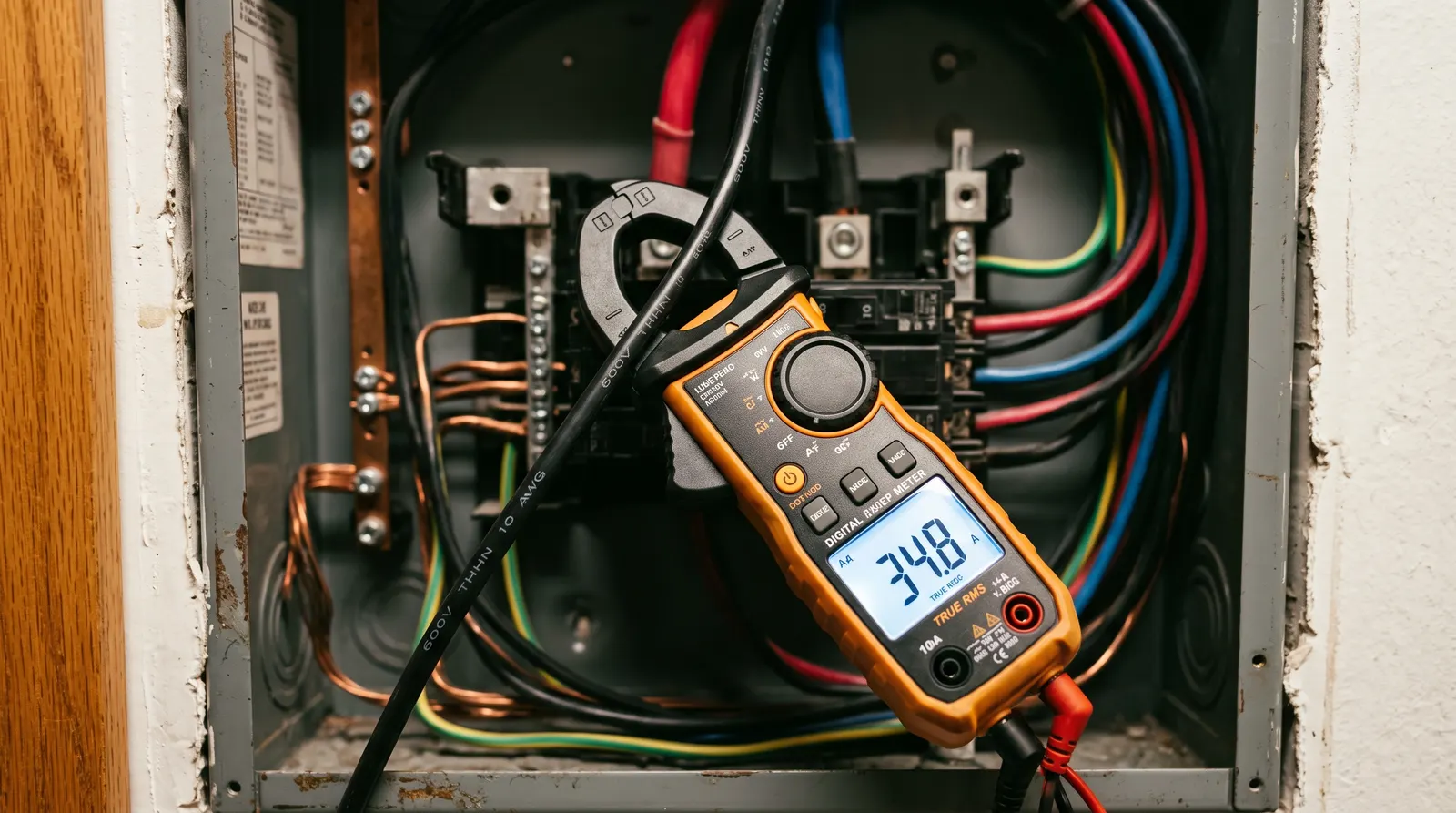
Clamp meter on the circuit
Unplug everything on the circuit, then try the reset. If it holds, the fault is in an appliance, not the wiring, and that changes who you call.
Independent, publicly published sources, quoted with attribution and linked in full.
None is affiliated with Emergency Services 24H, reviewed this page, or works in the referral network.
Thomas Adams: Oregon master electrician and business owner, Classic Electric - “If You Want To Know Why Your Breaker Trips, Watch THIS!” (2026)
Tell us what has failed and how soon you need someone. We route your request to licensed, insured contractors covering your area, and they contact you directly.
Fire, a gas smell, or an injury? Leave the building and call 911 first, then your gas
utility or power company. Use this form once you are safe.