A water damage ceiling stain tells you three things: whether it is still leaking, roughly how long it has been there, and which trade you need. A ceiling repair runs $1.50 to $3 per square foot of board (Bob Vila, read 2026-07-22), and a bulge is cleared before anything else.
Water stains appear where water finally drops, which is rarely where it got in. Repair runs $1.50 to $3 per square foot for the board and $3 to $4 for the drying (Bob Vila, read 2026-07-22).
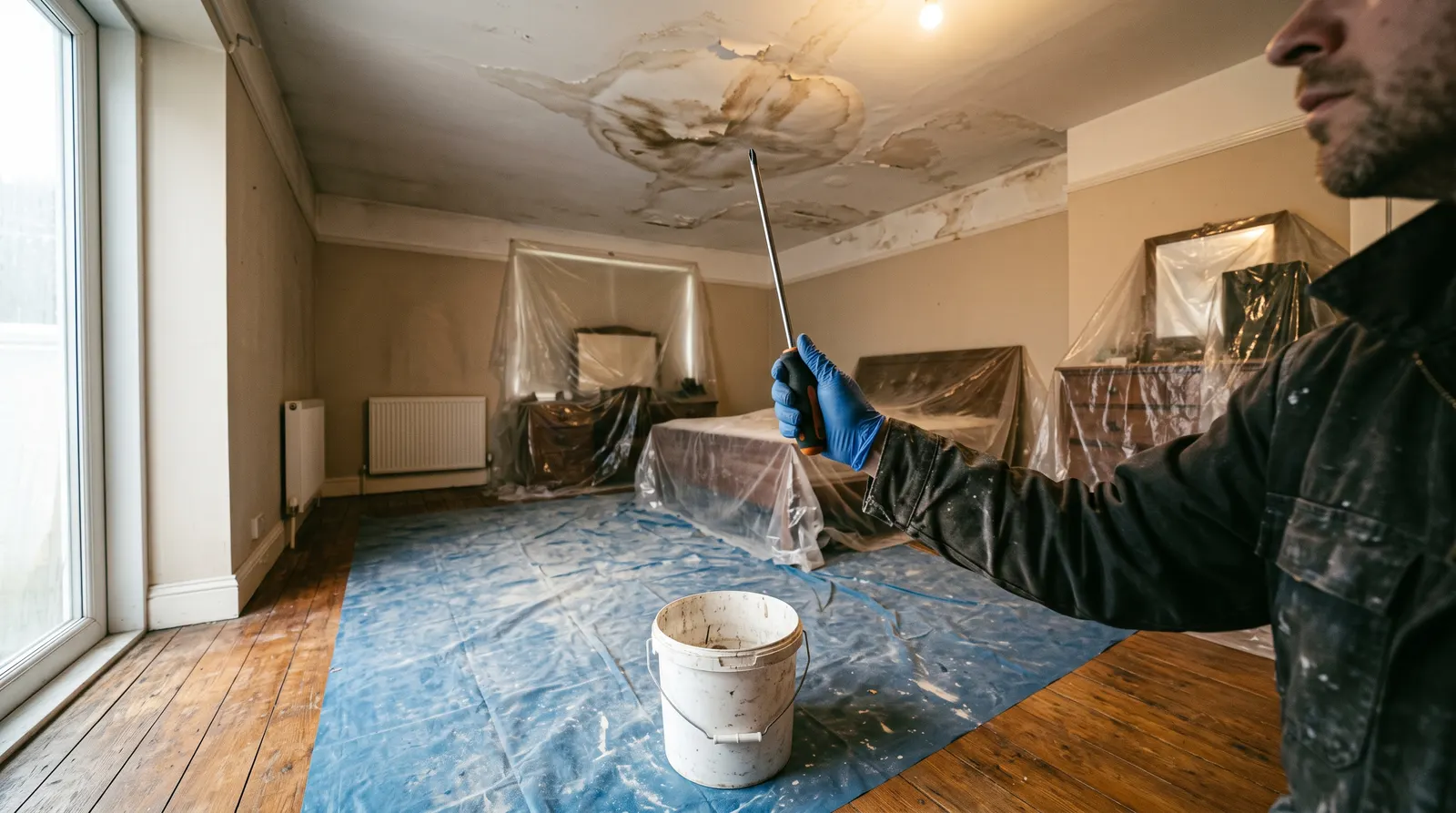
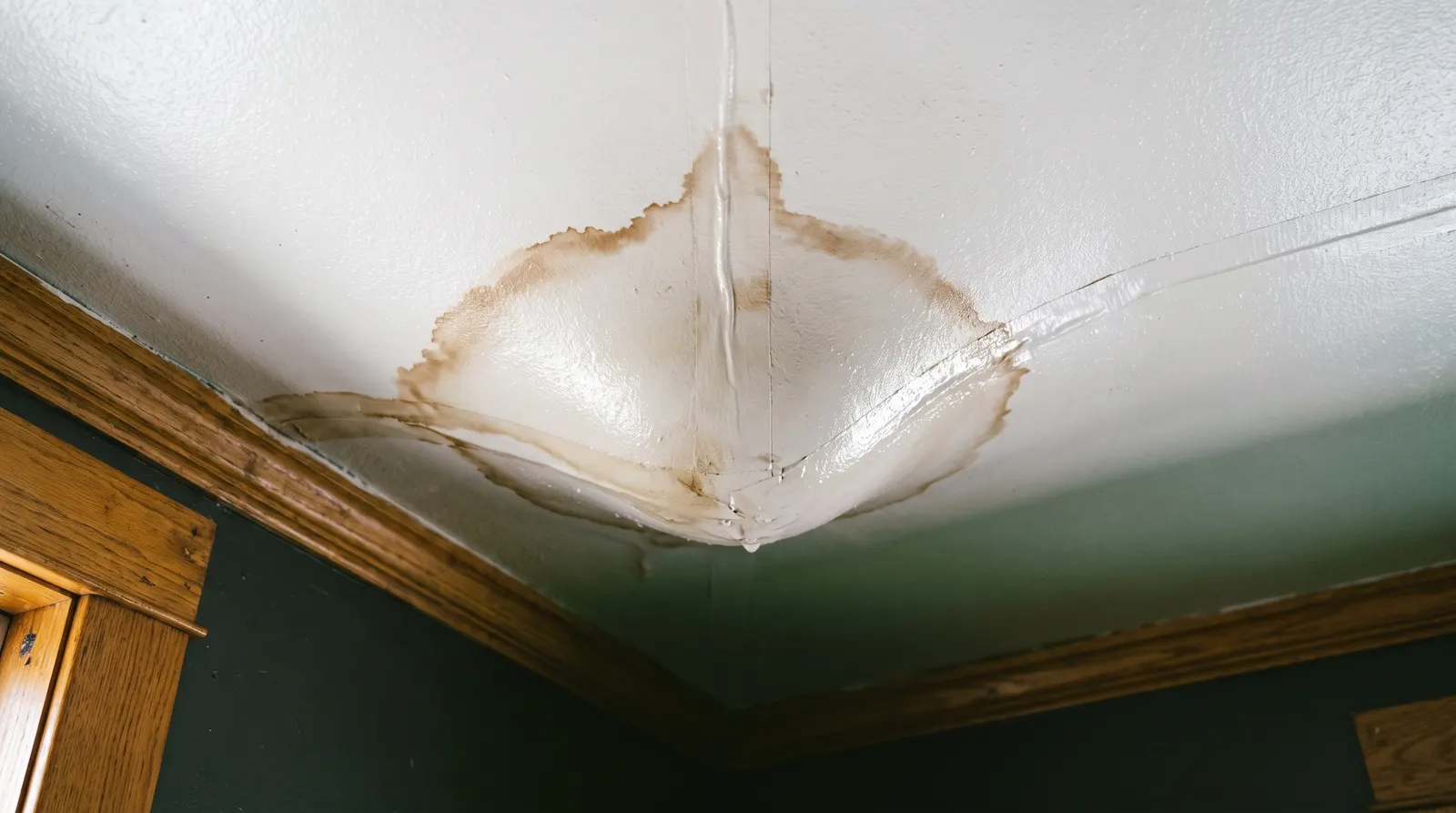
A bulging ceiling is holding a pocket of water, and when it fails it does so suddenly. Move people and furniture out from under it. Restoration crews often relieve the load with a small hole and a bucket, which beats waiting.
If nothing is sagging, you have time to read the water damage ceiling stain properly.
Sixty-second diagnosis
Read the stain, then trace the source
01
Check for sag first
A bulging area is holding water and weight. Clear furniture and people from underneath first.
02
Outline the stain in pencil
Draw around the edge and note the time. A line overtaken within an hour or two means active rather than historic.
03
Trace uphill along the structure
Water runs along joists before it drops. Look up-slope from the stain rather than directly above it.
04
Correlate with weather or usage
During rain and stopping between storms means roof. When a shower runs means plumbing. Seasonal and even means condensation.
Water damage ceiling stains: active or historic?
Is this stain still leaking?
Touch it and outline it. Cool and slightly soft means active. A crisp, dry, hard-edged ring that does not move over an hour or two is historic, and while it still needs the source identified, it is not tonight’s problem.
A historic stain still matters: water got in at least once and the cause may still be there. It does not mean standing under a ceiling with a bucket at midnight.
The source is almost never directly above
This is the insight that saves people opening the wrong section of ceiling.
Water entering a floor cavity does not fall straight down: it runs along a joist until it reaches a low point such as a light fitting.
In a level ceiling that is several feet from the entry point, and more in a sloped roof.
Trace uphill along the structure rather than upward through it. A light fitting is a penetration rather than the source, and the circuit gets isolated before you investigate.
Roof, plumbing or condensation?
Three causes with three distinct signatures, and the timing tells you which one you have.
Roof. Appears during or shortly after rain, stops between storms, and often correlates with wind direction. Top-floor ceilings only.
Plumbing. Appears when a fixture above is used: a shower, a bath, a toilet, a washing machine. Independent of weather.
Condensation. Seasonal, spreads evenly rather than forming a defined ring, and is worst in winter on uninsulated ceilings or in humid summers around ducts.
HVAC. A blocked condensate line from an attic air handler produces a stain that appears in cooling season and nowhere else.
The fourth is most often blamed on the roof. A working service technician from Word of Advice TV reports calls where an appliance was assumed to be leaking and the water had come from a furnace or humidifier nearby.
Above a ceiling the same happens along a joist: where you see water is where it arrived, and following it uphill is the diagnosis.
Which one you have decides how contaminated the water is. Under ANSI/IICRC S500 a clean supply line or rainwater is Category 1, a washing machine discharge above is Category 2, and anything from beyond a trap is Category 3 whatever it looks like.
Restoration instructor Darren Foote’s caution applies here, because a ceiling gives you little to judge by.
When the water is coming from a neighbor
Notify the neighbor and the building management in writing the same day, even if you also knock. Document your side thoroughly before anything is repaired, because once their plumber has fixed the source your evidence of the cause disappears with it.
The management company usually coordinates the repair, and liability resolves afterwards between insurers. Your job is documentation and speed.
What to do before the repair
Three things, and they are all about limiting the damage rather than fixing it.
Contain the drip and protect the floor beneath, then get air moving in the space above, because a ceiling dries from both sides and the cavity is the slow half. Do not paint over an active stain: primer over wet drywall traps moisture and the stain returns.
The EPA drying window of 24 to 48 hours applies here, and a water damage ceiling cavity is among the slowest spaces to dry.
Where the cut line goes
How much ceiling has to come out?
Back to genuinely dry material rather than back to the visible stain. Drywall wicks moisture beyond the mark, and insulation above a ceiling holds water longer than the board itself, so the wet zone is usually larger than it looks.
Moisture readings rather than appearance set that line. Wet insulation above the ceiling comes out too, because it will not dry in place and holds moisture against the new board.
Stain-blocking primer goes on only after a meter says the material is dry. Material rules are on our page about wet drywall and carpet.
Know the line
Safe to check yourself, or call a pro now
Safe to check yourself
Clearing the area under a sagging section
Outlining the stain and timing whether it grows
Correlating the stain with rain or with fixture use
Containing a drip and protecting the floor
Getting air moving in an accessible space above
Call a pro now
Any sagging or bulging section holding water
A stain around or near a light fitting
Anything on a top-floor ceiling during a storm
Cutting out ceiling drywall or removing wet insulation
Water arriving from a neighboring property
24/7 dispatch network
Get a licensed restoration contractor moving on this
Tell us whether the stain is growing and whether anything is sagging. Licensed, insured restoration contractors covering your area will contact you directly. No obligation.
Fire, a gas smell, or an injury? Leave the building and call 911 first, then your gas
utility or power company. Use this form once you are safe.
A saturated plasterboard ceiling can hold a surprising weight of water before it goes, and it goes all at once. Clear the room beneath first.
What ceiling repair costs
Indicative US ranges. Always get a written quote.
Job
Typical range
Notes
Drywall replacement
$1.50–$3 / sq ft
Cut back to dry material
Category 1 restoration, drying
$3–$4 / sq ft
Clean water from a supply line
Category 2 restoration
$4–$6.50 / sq ft
Appliance or waste-side water, read 2026-07-22
Mold remediation, if it started
~$2,200 average
A separate job from drying, read 2026-07-22
The source repair
separate trade, separate bill
Roofer or plumber, not the restorer
Source: Bob Vila 2026 water damage restoration cost data (retrieved August 2026). Figures vary by region and timing.
Figures last checked
The last row is the one people forget. A restoration contractor dries and rebuilds the ceiling but does not stop the water, and the source repair comes first.
Does homeowners insurance cover water damage to a ceiling?
Usually where the cause was sudden and accidental, such as a burst pipe, and usually not where it was gradual seepage or a maintenance failure. Insurance covers the water damage rather than the failed component, so the roof or pipe repair is normally yours.
What do early signs of water damage on a ceiling look like?
A yellow-brown ring, a soft patch, seams showing through the paint, or a hairline sag. Minor water damage looks like discolouration; what makes it active is a moving outline.
What are the common causes of a water damaged ceiling?
A roof or flashing leak, a supply or waste pipe in the floor above, a failed appliance, or condensation on a duct. The water source is rarely directly above the stain, because water runs along a joist before it drops.
Can I repair water damage on a ceiling myself?
Minor water staining on a ceiling that has dried, with the source fixed and a meter reading matching an unaffected area, is a paint-and-patch job. Anything sagging, spreading or still wet is a contractor job, and ceiling repairs run $1.50 to $3 per square foot of board (Bob Vila, read 2026-07-22).
How do I fix water damage if the leak has already happened and stopped?
Confirm it is historic with the outline test, fix the water source anyway, then meter the cavity before you paint. Primer over a wet cavity hides the problem rather than repairing it.
How do I know if a ceiling stain is still leaking?
Touch it and outline it. An active water stain on ceiling board feels cool and soft, and pencilled round the edge it grows within an hour or two. A historic stain is dry and hard with a crisp ring.
Is a sagging ceiling dangerous?
Yes. A bulging ceiling is holding a load it was never designed for. Clear furniture and people from underneath first, and restoration contractors will often relieve it with a small drain hole rather than wait for it to fail.
Why is the leak not directly above the stain?
Because water runs along joists and pipe runs before it drops at the first low point, which can be several feet from the leak. Trace uphill rather than assuming the water source is overhead.
Is it a roof leak or a plumbing leak?
Roof leaks track the weather and stop between storms. Plumbing leaks track usage, appearing when a shower runs. Condensation is seasonal and spreads evenly rather than in a ring.
What if the water is coming from the flat above?
Notify the neighbor and building management in writing, and document your side before anything is repaired. The management company usually coordinates the repair and liability follows afterwards.
How much does ceiling water damage repair cost?
Drywall replacement runs $1.50 to $3 per square foot and drying about $3 to $4 (Bob Vila, read 2026-07-22). If mold has established, remediation averages about $2,200 as a separate job, and the source repair is a separate trade again.
Relieving the water deliberately
A ceiling holding water
Fixing the ceiling before fixing the source is the most common expensive mistake on this repair. Find the leak first.
Tell us what has failed and how soon you need someone. We route your request to licensed, insured contractors covering your area, and they contact you directly.
Fire, a gas smell, or an injury? Leave the building and call 911 first, then your gas
utility or power company. Use this form once you are safe.