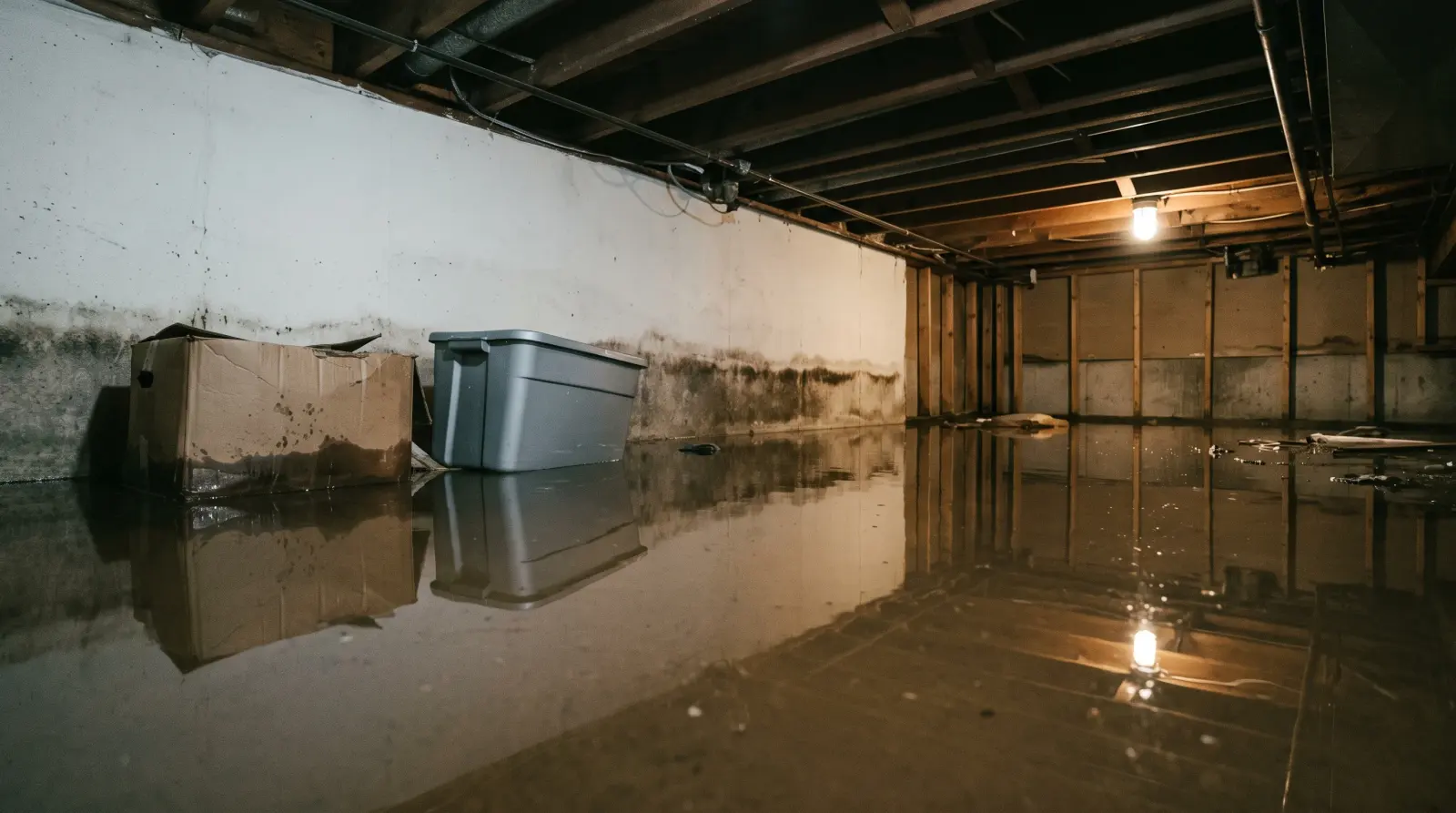
Water in basement after rain is groundwater finding a path, and cleanup runs $4 to $6.50 per square foot each time. The five causes run cheapest first: gutters, grading, window wells, the sump pump, then drainage. The quick answer is that it is a drainage fault, not a burst pipe.
That decides the fix, who you call, and the insurance answer, because homeowners insurance covers neither basement flooding from rain nor surface water. The water damage and restoration guide covers cleanup, and Emergency Services 24H routes the work.
Water in basement after rain is groundwater, not a leak
Is rain-driven basement water a plumbing problem?
No. If it correlates with rainfall it is surface water or groundwater finding a route in, which makes it a drainage problem rather than a plumbing one. Different trade, different fix, and an insurance answer that almost always comes back excluded.
The reframe changes who to call. A plumber will not help, and a restoration contractor dries the basement floor without stopping the seepage.
It also explains the pattern people describe: water in basement after rain, dry the rest of the month, and no visible plumbing fault anywhere.
Work them cheapest first
The five causes, in the order that saves money
01
Gutters and downspouts
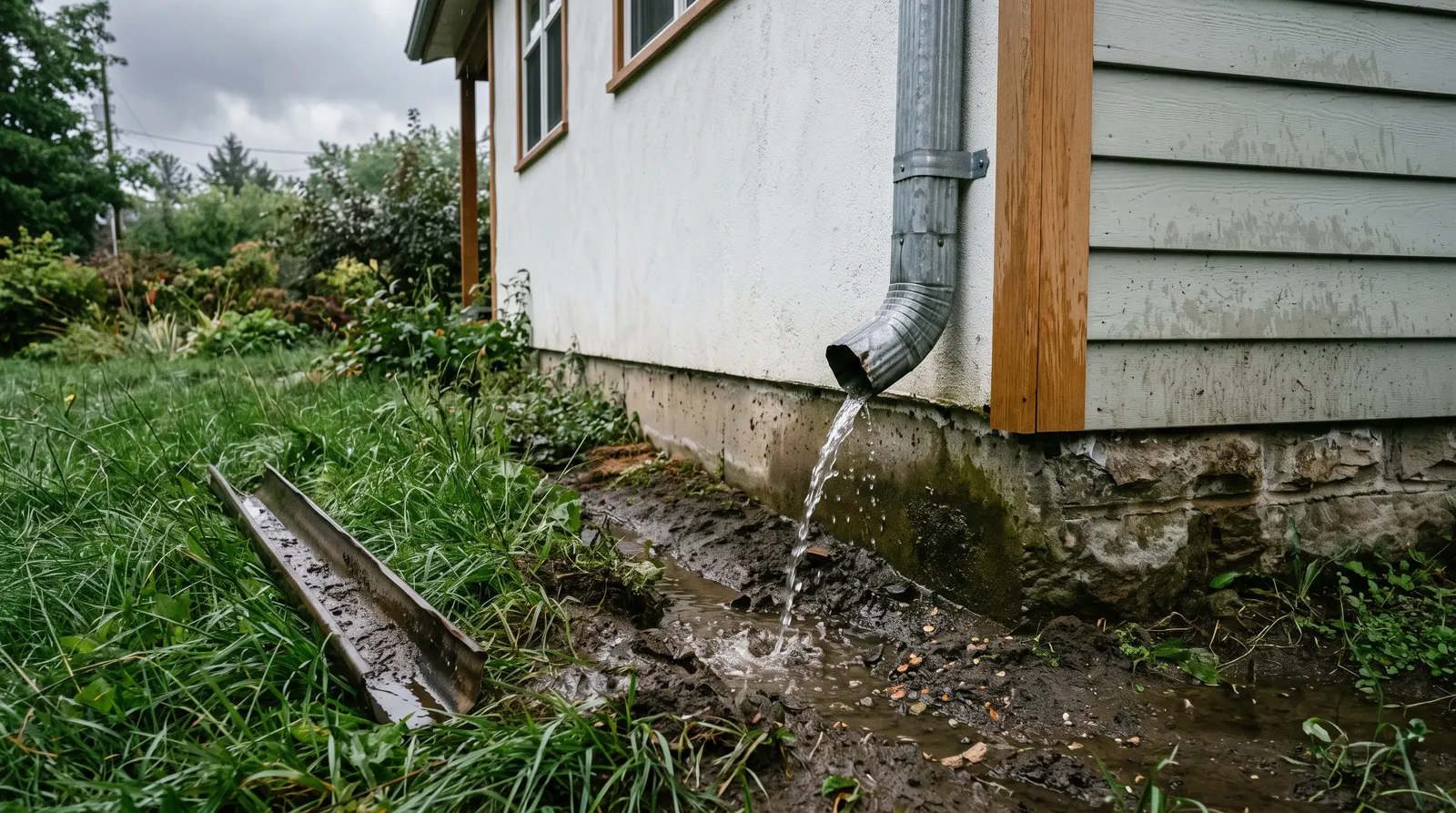
The cheapest and commonest cause: a blocked gutter or a downspout at the wall puts a roof of water against the foundation.
02
Grading against the wall
Ground settled toward the house funnels surface water down the foundation rather than away.
03
Window wells
A well with a blocked or missing drain becomes a bucket held against a below-grade window, and the window is not designed to be underwater.
04
Sump pump and footing drain
The expensive end: a pump that failed, or a silted footing drain, which is when interior drainage becomes the conversation.
Cited source~7:30
Reading clause 2.1 of the IICRC S500 standard aloud.
“Mitigation following water damage events should begin as soon as safely possible.”
SM
Scott McFadzen
Member of the ANSI/IICRC S500 2018 consensus body
Coach8, 2022
An independent source we cite. Not affiliated with Emergency Services 24H, and not a network contractor.
Contractors ranking for this lead with interior drainage, the most expensive answer and occasionally the right one. Working the list in order costs almost nothing.
Gutters and downspouts do most of the work
A single storm over an average roof sheds thousands of gallons, and gutters exist to take it away from the building.
When a gutter blocks, the water lands in a line at the base of the wall. A downspout discharging at the foundation does it more efficiently.
Clear the gutters, then extend every downspout so it discharges clear of the house. A morning’s work, and it ends a real share of basement leaks.
Grading: the slope that matters
Ground should fall away from the foundation for the first several feet. Backfilled soil settles and reverses that slope, and beds against the outside wall make it worse.
The test: after heavy rain, does water pool against the house. Puddles of water there go down the outside of the foundation and into whatever gap they find.
How hydrostatic pressure gets water through concrete
How does water get through a solid wall?
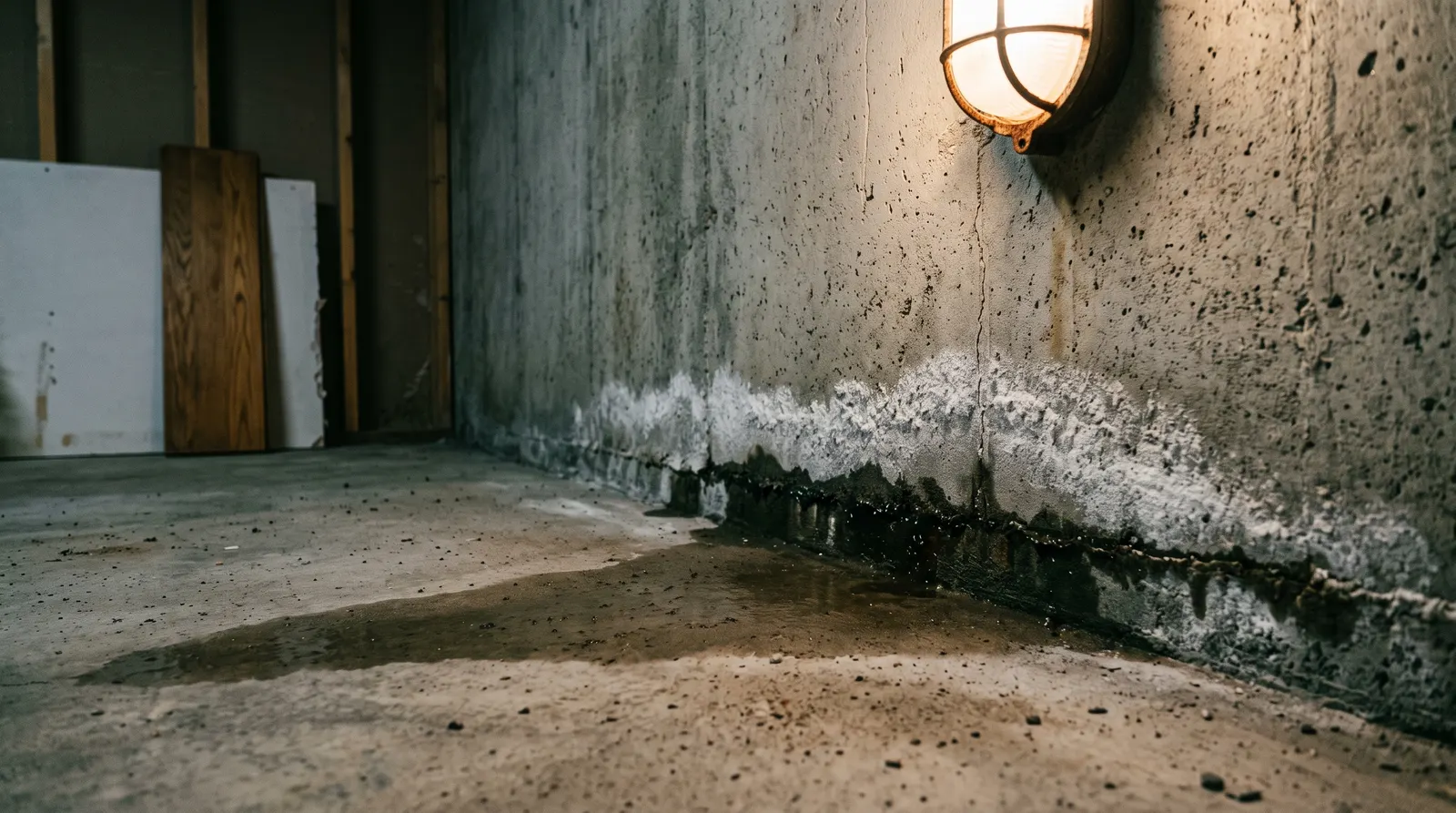
Saturated soil around the foundation pushes water against the wall under pressure. Concrete is not waterproof, and under sustained pressure water moves through the cold joint where wall meets footing, through hairline cracks, and through porous block.
This is why the cheap fixes work: they reduce the water in the soil against the wall, and so the pressure driving water seepage through it.
It is why sealing paint applied inside fails: it addresses the last inch of a problem driven from outside by feet of saturated ground.
The sump pump, and why it fails when needed
Sump pumps fail during storms with a reliability that feels malicious, and the reason is straightforward: the storms that produce the groundwater also produce the power cuts.
Power is not the only failure mode. A homeowner who documented his own basement flooding found the pump working: the bottleneck was the diameter of the discharge pipe, which could not move water as fast as it arrived.
A pump rated for the volume is useless behind a pipe that is not, and it costs nothing to look at yours before the season.
His prevention list is worth more than most vendor checklists because he paid for it: floor-level water alarms, a backup pump, a larger discharge pipe, a longer discharge run, regrading, and gutters sized for the storm that turns up.
Test it before the season by pouring a bucket of water into the pit and watching it cycle.
A battery backup unit is the fix for the power-cut case, and it is the single most useful upgrade here.
Check the discharge line is not blocked, frozen or discharging somewhere that drains straight back.
Listen for short cycling, which usually means a stuck float or an undersized pit.
Never run a generator indoors
People bring generators into garages and basements during storm power cuts specifically to run a sump pump, and it is one of the most reliably fatal decisions in home ownership. Generators produce carbon monoxide, which is colorless and odourless. Outdoors only, well away from doors, windows and vents.
Most recurring basement water is a drainage problem outside the wall, not a waterproofing problem inside it. Fix the gutters and grading first.
What each option costs against doing nothing
Indicative US ranges. Always get a written quote.
Job
Typical range
Notes
Gutter clearing and downspout extensions
lowest-cost fix
Resolves a real share of cases
Regrading around the foundation
moderate, landscaping trade
Second cheapest and often decisive
Battery backup sump pump
moderate, one-off
For the failure that happens in the storm
Repeated cleanup, Category 2 water
$4–$6.50 / sq ft each time
What doing nothing costs, repeatedly
Flooded basement cleanup
$2,000–$7,000
Average around $4,000 per event, read 2026-07-22
Source: Bob Vila 2026 water damage restoration cost data; consumer-reported cleanup figures from published aggregators, marked as reported (retrieved August 2026). Figures vary by region and timing.
Figures last checked
Read that against the fourth row: repeated Category 2 cleanup at $4 to $6.50 per square foot (Bob Vila, read 2026-07-22) is what people choose by not acting.
Why insurance almost certainly will not pay
Standard homeowners policies exclude flood and surface water, and rain-driven basement water is exactly that. Sump pump failure is normally excluded too without a water backup endorsement.
Flood cover usually means an NFIP policy with a 30-day waiting period, so buying one during a wet week does not help that week. FEMA puts one inch of water at about $25,000 of damage.
Sometimes it is, and dismissing it entirely would be as dishonest as leading with it.
Interior drainage, a channel cut around the perimeter feeding a sump, is right where water enters at the cold joint and the surface causes are fixed. That last clause is the one contractors skip.
Price it against repeated cleanup, not zero. Cleaning up twice a year at several thousand dollars makes a one-off system look different. If you have never cleared your gutters, it does not.
How the matching works, and what we do not do
Emergency Services 24H is a referral service, and does not employ waterproofing contractors or sell drainage systems.
Your request routes to licensed, insured contractors nearby. To remove water from the basement first, see what to do about a flooded basement.
Know the line
Safe to check yourself, or call a pro now
Safe to check yourself
Clearing gutters and extending downspout discharge
Checking whether water pools against the wall after rain
Clearing and draining window wells
Testing the sump pump with a bucket before the season
Fitting a battery backup pump
Call a pro now
Regrading that involves moving significant soil or hard landscaping
A footing drain that has silted up
Structural cracks rather than hairline ones
Water entering at the cold joint after surface causes are fixed
Any basement with standing water near electrics
24/7 dispatch network
Get a licensed restoration contractor moving on this
Tell us where the water comes in. Licensed, insured contractors covering your area will contact you directly. No obligation to hire, and no obligation to buy the biggest system offered.
Fire, a gas smell, or an injury? Leave the building and call 911 first, then your gas
utility or power company. Use this form once you are safe.
Straight answers
Frequently asked questions
The questions homeowners actually search for on this problem, answered in plain language.
Why does my basement leak when it rains but stay dry otherwise?
Because the water arrives with the storm and leaves with it. A basement that leaks when it rains is taking surface water or a raised water table through the wall, which is why the floor is dry two days later and wet in the next storm.
Is water coming up through the basement floor different from wall seepage?
Yes. Water coming up through the basement floor drain after heavy rain is hydrostatic pressure under the slab, pointing at the footing drain and sump. Wall seepage points at gutters first.
Is a small amount of water in the basement normal?
Common, and not harmless. Repeated wetting starts the mold clock, so treat a recurring puddle as a drainage fault, and keep the basement dry between storms.
Why does water come into my basement when it rains?
Because rainwater is finding a path through the foundation rather than a pipe bursting. In order of cost: blocked gutters and short downspouts, ground sloping toward the house, window wells with no drainage, a failed sump pump, then foundation cracks.
Is water in the basement after rain covered by insurance?
Almost certainly not. Groundwater and surface water are flood, which standard policies exclude, so insurance covers water in the basement only where an endorsement or NFIP policy is already in force, and NFIP carries a 30-day wait.
What is the cheapest thing that actually works?
Gutters and downspouts. A blocked gutter or a downspout at the wall delivers a whole roof of water against the foundation. Clearing and extending them costs little and ends a real share of cases.
Do I need a full waterproofing system?
Sometimes, and not before the cheap causes are ruled out. Interior drainage suits water coming up through the basement floor under pressure. A contractor quoting basement flooding solutions before looking at your gutters is selling.
Why does my sump pump fail exactly when I need it?
Because the storms that produce the water produce the power cuts, so a sump pump with no battery backup is unavailable in the conditions it exists for. Test it with a bucket before the wet season.
Will it get worse over time?
Usually yes: soil settles, gutters block, and basement floor cracks widen through freeze-thaw. To prevent basement flooding, fix water at the cheap end early.
Where rainwater actually gets in
The gutter and grading fix
The cheapest row fixes a large share of cases. Start at the top of this chart and only move down it if the water persists.
Sources for this page
Texas Department of Insurance: When water damage and mold are covered by insurance: sudden and accidental versus gradual and flood
Independent, publicly published sources, quoted with attribution and linked in full.
None is affiliated with Emergency Services 24H, reviewed this page, or works in the referral network.
Scott McFadzen: Member of the ANSI/IICRC S500 2018 consensus body, Coach8 - “Reviewing the ANSI/IICRC S500 2021 Standard, 5th Edition” (2022)
Tell us what has failed and how soon you need someone. We route your request to licensed, insured contractors covering your area, and they contact you directly.
Fire, a gas smell, or an injury? Leave the building and call 911 first, then your gas
utility or power company. Use this form once you are safe.